

Watch Value Guide: How to Price Luxury, Vintage, and Everyday Watches
To identify a vintage watch, start with the caseback and the space between the lugs — the reference and serial numbers there give you the model and roughly the year. This guide shows where to find them, then how originality, condition, service history, and box and papers move the price for luxury, vintage, and everyday watches.
6 min readBy PriceSnap Editorial TeamPublished
AI summary
This guide explains watch valuation using brand, model, reference, movement, dial, case condition, originality, service history, box and papers, authenticity risk, and comparable sales.
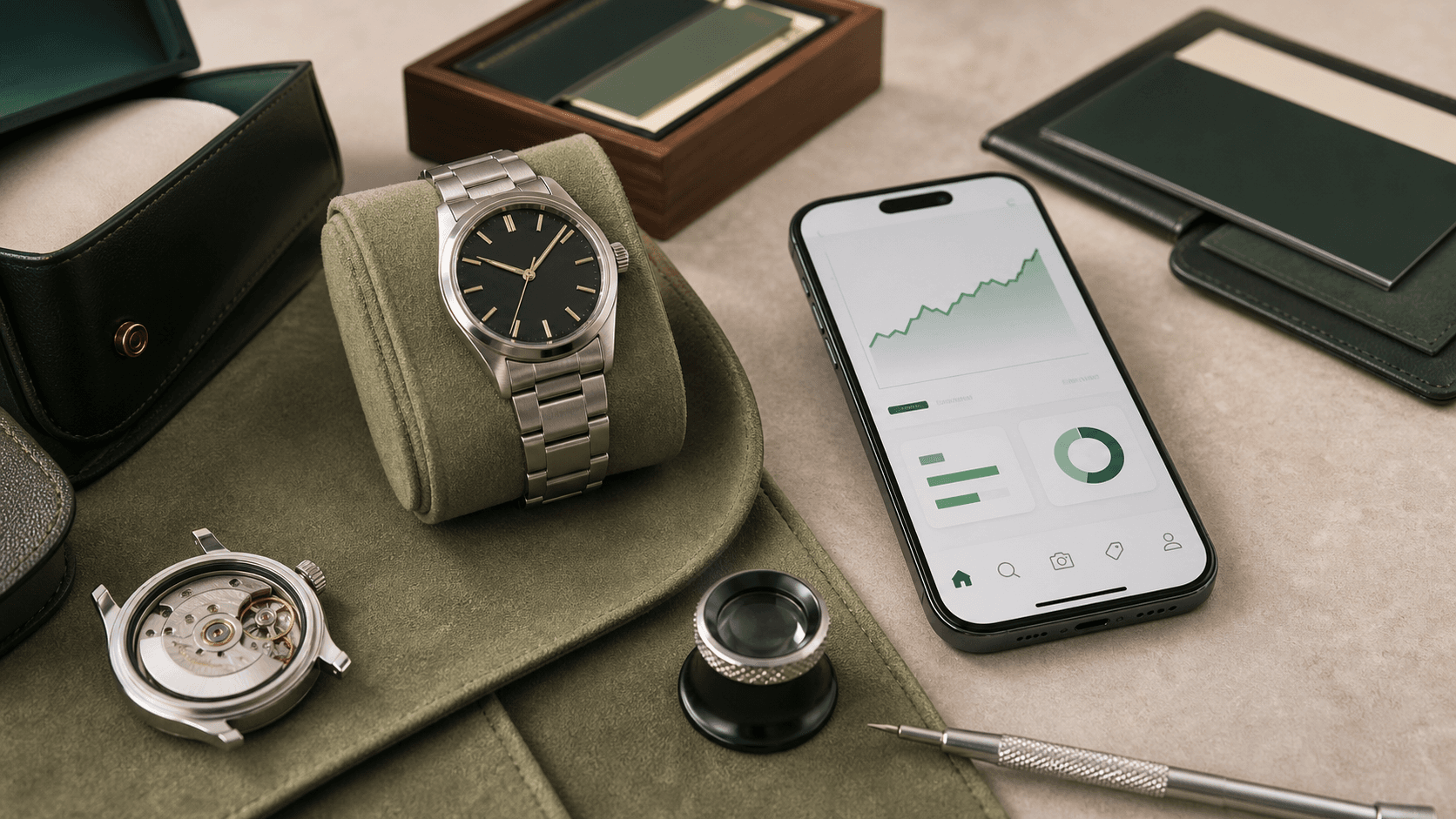
PriceSnap is a mobile app for iOS and Android.
Use the app while reading this guide to scan items, estimate resale value, check marketplace comp signals, and save finds to your collection.
Key takeaways
- The reference number, model, movement, case size, and dial variant are essential for watch pricing.
- Condition, originality, polishing, service parts, and bracelet stretch can materially affect value.
- Box, papers, receipts, and service history can increase buyer confidence.
- PriceSnap can provide a starting estimate, but high-value watches should be authenticated and inspected.
Try alongside this guide — scan straight from your camera roll.
Find the Reference and Model
Watch pricing starts with exact identification, and on a watch that identification is stamped into the metal rather than printed on a label. The reference number is the single most useful string you can recover: it encodes the model, case material, bezel type, and often the dial configuration. Look between the lugs where the bracelet meets the case, on the caseback, on the inside of the caseback for some vintage pieces, and on the warranty card or papers if the set is complete. Alongside the reference, record the brand, model name, case diameter, movement type, dial variant, bracelet or strap, and approximate production period. Small differences matter more here than in almost any other collectible category. A dial that reads one line differently, a bezel insert in a different font, or a production year that straddles a movement change can move the same nominal model into a completely different demand band. If you cannot find a reference number, photograph the caseback, the dial text in full, and the clasp, and treat every estimate as provisional until the reference is confirmed.
- Between the lugs, under the bracelet or strap — the most common location for a reference number.
- Engraved on the outside of the caseback, often alongside the serial number.
- Inside the caseback on many vintage pieces — only accessible to a watchmaker.
- On the warranty card, service papers, or original receipt if the set is complete.
- On the clasp, which frequently carries its own code identifying the bracelet.
| Movement | How to recognise it | What it signals for value |
|---|---|---|
| Manual wind | Seconds hand sweeps; must be wound daily; no rotor visible through a display back | Common in vintage; service parts availability drives long-term cost |
| Automatic | Sweeping seconds hand; winds from wrist motion; rotor visible through a display back | The mainstream of collectible mechanical watches |
| Quartz | Seconds hand ticks once per second; battery powered | Usually lower resale outside a few specific collectible references |
| Solar or kinetic | Quartz-style tick, no battery change required | Niche demand; condition of the capacitor matters |
Read next:Watch value checker
Originality and Condition Are Different Things
New collectors often conflate a clean watch with a valuable one. In vintage watches especially they are separate axes, and originality usually outranks cosmetic freshness. Collectors care about original dials, hands, bezels, crowns, bracelets, and case geometry. A watch that has been polished repeatedly loses the sharp bevels and defined lug edges that signal an unmolested case, and no amount of shine brings that back. A redial — a dial repainted during service — can be very hard to spot in a photograph but is usually obvious to a specialist and can cut value substantially. Service hands, aftermarket bezel inserts, replacement crowns, and relumed markers all shift a watch away from original configuration. Meanwhile genuine wear on an original watch is often forgiven. The practical rule: describe what is original before you describe what is clean, and if you do not know whether a component is original, say so rather than guessing.
- Rounded lug edges and soft case bevels — the signature of heavy polishing.
- Dial printing that looks slightly too crisp, or fonts that do not match known examples — possible redial.
- Lume on hands and markers that glows a different colour or intensity — mismatched or relumed parts.
- A bracelet that does not taper or finish like the factory original.
- Moisture marks, foggy crystal, or rust on the movement — water damage that may not be fully reversible.
Box, Papers, and Service History
Original box, warranty card, receipts, tags, manuals, and service records create trust, and in the luxury segment trust converts directly into money. A watch offered as a full set — watch, box, papers, and any extra links — typically clears faster and higher than the identical reference sold bare, because the paperwork does part of the authentication work for the buyer. Where papers exist, check that the serial number on the card matches the watch itself; a mismatched set is worth less than an honest watch-only offer, because it raises questions the seller cannot answer. Service history cuts both ways. A recent service from a reputable independent watchmaker or the manufacturer supports value and reassures a buyer that the movement runs. An unknown service history on a mechanical watch that has not been opened in decades makes buyers price in a service they will have to pay for. Keep receipts, and if a service replaced original parts, say which ones.
| Description | What it includes |
|---|---|
| Full set | Watch, original box, warranty card or papers, booklets, and spare links |
| Watch and box | No papers — authentication rests on the watch itself |
| Watch only | Often called "head only" when the bracelet is also absent |
| Service papers | Documentation of work performed, distinct from the original warranty card |
Compare Similar Examples
Compare sold watches with the same reference, dial, material, bracelet, condition, and box/papers status. Every one of those variables can move the number, so a comp that matches on four of six is a weak comp. Asking prices are especially unreliable in luxury watches, where sellers routinely list well above the level at which watches actually change hands and simply wait. Use completed sales or accepted-offer signals where the platform exposes them. Watch out for two specific distortions. First, dealer prices include a warranty, authentication, and a return window, so a dealer listing is not a comparable for a private sale. Second, auction results are reported inconsistently — some include the buyer's premium and some do not, which can shift the effective price by a fifth. When comps are thin for an unusual reference, widen the date range rather than loosening the specification, and lower your confidence accordingly.
Read next:Sold listings vs asking prices
Authentication and Inspection
Counterfeits and modified watches are common in high-value categories, and the quality of the best fakes has risen to the point where photographs alone are not a reliable test. Beyond outright counterfeits there is a middle category that catches more sellers: the assembled or "franken" watch, built from a genuine case, a replacement dial, and a movement from a different reference. Every individual part may be authentic while the watch as a whole is not what the listing claims. Photo-based estimates, including PriceSnap's, are a starting point for research rather than an authentication decision. Treat the two questions separately: what is this watch, and is this watch what it appears to be. If a watch may be expensive, get it inspected by a watchmaker or a specialist dealer before you buy it, sell it, or insure it. The cost of an inspection is small against the cost of being wrong on a four-figure purchase.
- A photo estimate answers "what is this likely worth if genuine" — never "is this genuine".
- Ask to see the movement on any mechanical watch above a few hundred dollars.
- Mismatched serial numbers between case, papers, and movement are a stop signal.
- Buy the seller as well as the watch: history, feedback, and willingness to allow inspection.
Most Watches Are Not Luxury Watches
Guides like this one naturally gravitate towards the expensive end, but the majority of watches you encounter in a thrift store, an estate lot, or a family drawer are fashion or department-store pieces, and it is worth being realistic about them. A quartz fashion watch with a dead battery, a worn strap, and no collector following will usually cost more in shipping, packaging, and listing time than it returns. There are exceptions worth learning: certain vintage quartz references, mechanical watches from mid-tier makers with active collector communities, military-issued pieces, and unusual complications can all outperform expectations. The useful habit is to run a quick check rather than assuming either direction. Sort a mixed lot into three piles — obviously modern fashion, unknown mechanical, and anything with a recognisable name — and spend your research time on the second and third piles. Batch the first pile as a single lot if you sell it at all.
Read next:What not to buy at thrift stores
Common Watch Valuation Mistakes
The errors that cost the most money are repetitive, which means they are avoidable. Most of them come from treating a watch as a single object with a single price rather than as a configuration of parts whose originality and completeness must each be established. The list below covers the mistakes that most often turn an expected profit into a loss or a stalled listing.
- Pricing from the model name alone, without the reference number that distinguishes variants.
- Using retail or boutique price as a resale anchor — the secondary market sets its own level.
- Comparing a full set against a watch-only example, or a dealer listing against a private sale.
- Assuming a running watch keeps accurate time; a watch can run and still need a full service.
- Polishing a vintage case before sale, which usually removes value rather than adding it.
- Describing a watch as authentic on the strength of a photograph rather than an inspection.
- Ignoring the cost of a service the buyer will price in on an unserviced mechanical watch.
How to Scan Watches With PriceSnap
Photograph the dial straight on in even light, then the case sides, the caseback, the bracelet or strap, the clasp, and any visible reference or serial details. Avoid direct flash, which blows out the crystal and hides the dial text that identification depends on; angle the watch slightly under a window instead. Add notes for service history, known issues, and whether box and papers are present, because those change the range materially. PriceSnap returns a directional range that tells you whether deeper watch research is justified — whether this is a piece worth a specialist's time, or a fashion watch to batch into a lot. For anything that comes back at a level where the answer matters, treat the scan as the first step and a specialist inspection as the last one.
Read next:How PriceSnap estimates resale valueJewelry value guide
Related categories
FAQ
Watch Value Guide: How to Price Luxury, Vintage, and Everyday Watches — FAQ
Straight answers about accuracy, platforms, and how PriceSnap fits your workflow.
How do I find the value of a watch?
Identify the brand, model, reference, movement, size, dial, condition, service history, and box/papers status, then compare recent sales.
Do box and papers affect watch value?
Yes. Original box, papers, receipts, warranty cards, and service records can improve buyer confidence and may increase resale value.
What condition issues lower watch value?
Heavy polishing, replacement parts, dial damage, water damage, poor timekeeping, bracelet stretch, missing links, and unknown service history can lower value.
Can PriceSnap scan watches?
Yes. PriceSnap can scan watch photos for a directional value estimate, but expensive watches should be authenticated and inspected by a specialist.