

5 min readBy PriceSnap Editorial TeamPublished Updated
Jewelry Value Guide: How to Find What Your Jewelry Is Worth
Jewelry valuation is complex — the same ring might have a $500 melt value, a $1,200 fair market value, and a $2,500 insurance replacement value. This guide explains the key factors in jewelry pricing and how to use both AI tools and professional appraisers effectively.
AI summary
This guide explains how to estimate jewelry value using hallmarks, metal purity, gemstone quality, designer marks, melt value, resale value, and appraisal signals.
PriceSnap is a mobile app for iOS and Android.
Use the app while reading this guide to scan items, estimate resale value, check marketplace comp signals, and save finds to your collection.
Key takeaways
- Jewelry value starts with metal purity, gemstone quality, weight, condition, and brand.
- Resale value is usually different from insurance replacement value.
- Hallmarks, designer signatures, certificates, and boxes can materially affect price.
- PriceSnap can scan jewelry as a starting point, but high-value stones need expert verification.
Try alongside this guide — scan straight from your camera roll.
Reading Jewelry Hallmarks
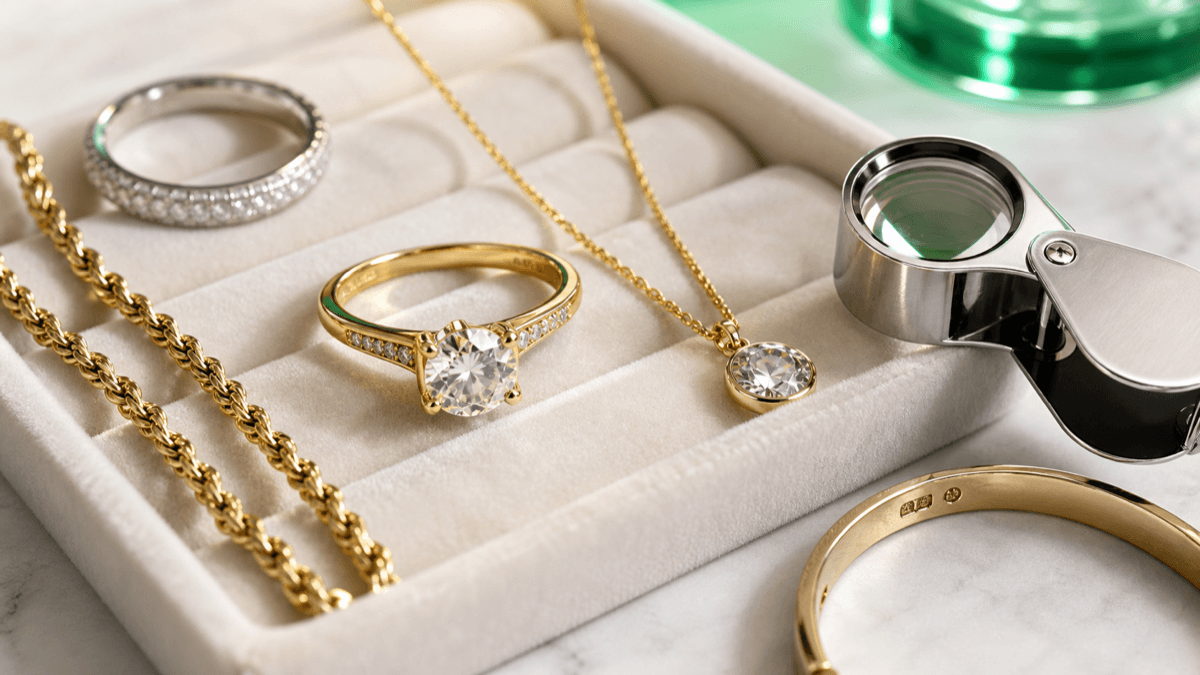
Hallmarks tell you the metal purity and often the maker, and finding them is the first step in any jewellery valuation because purity sets the floor. US gold hallmarks run 10K (41.7% gold), 14K (58.3%), 18K (75%), and 24K (99.9% pure). Silver marked "925" or "Sterling" is 92.5% silver. UK jewellery uses a more elaborate system with date letters, assay office marks, and maker's marks, which means a British hallmark can often date a piece precisely. Learn two abbreviations that catch people out constantly: "GF" means gold-filled and "GP" means gold-plated, and neither is solid gold — the metal value of a plated piece is negligible regardless of how convincing it looks. Marks are usually inside a ring shank, on a clasp, on the reverse of a pendant, or on the underside of a bail. Use magnification and raking light; hallmarks are small and frequently worn.
| Mark | Meaning |
|---|---|
| 10K | 41.7% gold |
| 14K | 58.3% gold |
| 18K | 75% gold |
| 24K | 99.9% pure gold |
| 925 / Sterling | 92.5% silver |
| GF | Gold-filled — not solid gold |
| GP | Gold-plated — negligible metal value |
Read next:Jewelry value checker
Diamond Grading: The 4 Cs
Diamonds are graded on Cut, Colour, Clarity, and Carat weight. Cut — graded Excellent, Very Good, Good and below — has the largest effect on how a stone actually looks, and a poorly cut stone of high colour and clarity can appear duller than a well-cut stone that grades lower on paper. Colour runs from D (colourless) to Z (light yellow), with D through G considered colourless and commanding premiums. Clarity runs from FL (Flawless) to I3 (heavily included), and VS1 through SI1 is generally regarded as the value sweet spot because inclusions in that band are difficult to see without magnification. Carat weight affects price directly, with noticeable jumps at the half-carat and whole-carat thresholds because those sizes are in demand. A stone just under a threshold often represents better value than one just over it, for reasons that have nothing to do with how it looks.
| C | Scale | Note |
|---|---|---|
| Cut | Excellent to Poor | Largest effect on appearance |
| Colour | D (colourless) to Z (light yellow) | D-G considered colourless |
| Clarity | FL (flawless) to I3 (heavily included) | VS1-SI1 often the value sweet spot |
| Carat | Weight in carats | Price jumps at half- and whole-carat thresholds |
Ask for the Certificate
For any diamond of meaningful size, a grading report from an independent laboratory is the difference between a described stone and a documented one, and buyers price the two very differently. GIA is the most widely recognised laboratory and its reports are treated as the reference standard; other laboratories exist and their grading is not always regarded as equivalent, which is why a stone's certificate should be read for which laboratory issued it as well as what it says. A report typically records the 4 Cs, measurements, proportions, fluorescence, and a plotted diagram of inclusions that lets you match the report to the physical stone. If a seller has no certificate for a significant diamond, that is not automatically a problem — many older pieces were never certified — but it does mean the grading is somebody's opinion rather than a documented assessment, and you should price for that uncertainty.
- Check which laboratory issued the report; they are not all treated as equivalent.
- Match the report's measurements and inclusion plot to the physical stone.
- Note fluorescence, which affects price and is often overlooked.
- An uncertified stone is not necessarily a problem, but grade it conservatively.
- A certificate grades the stone; it does not value the finished piece.
Resale Value vs. Replacement Value
This distinction is the single largest source of disappointment in jewellery selling, and understanding it before you get an offer saves a great deal of frustration. Replacement value, used for insurance, is what it would cost to replace an item with a comparable new piece at retail, and it is typically a multiple of what the piece would actually fetch. Fair market value is what a willing buyer would pay a willing seller — realistically, what you would receive selling to a jeweller or through a resale platform. Retail jewellery loses a large share of its value the moment it leaves the store, because the retail price includes design, marketing, retail margin, and overhead that no secondary buyer will pay for. Designer pieces, signed work, and rare stones retain more. If you hold an insurance appraisal and expect to sell at that figure, you will be disappointed; the appraisal is answering a different question.
| Valuation | Question it answers | Used for |
|---|---|---|
| Replacement value | What would it cost to buy a comparable piece new at retail? | Insurance cover |
| Fair market value | What would a willing buyer pay a willing seller? | Selling, estate, tax |
| Melt value | What is the raw metal worth at spot price? | The floor for scrap and broken pieces |
Know the Melt Floor Before Any Offer
Every solid precious-metal piece has a floor: its melt value, which is the weight of pure metal it contains multiplied by the current spot price. Work this out before you speak to a buyer, because it tells you immediately whether an offer is serious. Weigh the piece in grams, apply the purity from the hallmark — 58.3% for 14K, 75% for 18K, 92.5% for sterling — and multiply by the spot price per gram. Remember to subtract stones and any non-precious components from the weight, since a buyer paying melt is not paying for those. The resulting figure is what the piece is worth as raw material, and no offer below it should be accepted for an intact piece. Refiners typically pay melt less a processing margin, which is appropriate only for broken or unwearable items. Anything wearable, signed, or set with meaningful stones should be worth more than melt as a finished piece.
- Weigh in grams; subtract stones and non-precious components.
- Apply the purity from the hallmark, not the karat number itself.
- Multiply by the current spot price per gram for that metal.
- Never accept below melt for an intact, wearable piece.
- Refiner offers sit below melt by a processing margin — for scrap only.
Where to Sell Jewelry for Maximum Value
Selling directly through general marketplaces typically returns the most, but it takes time, requires good photographs and clear authentication evidence, and exposes you to the dispute risk that comes with high-value shipped goods. Estate jewellery dealers pay a fraction of market value but offer speed, certainty, and no post-sale obligations. Auction houses suit rare or high-value pieces, where their buyer reach exceeds anything you could achieve privately, at the cost of commission and a longer timeline. Refiners pay melt less a fee and are appropriate only for broken or non-wearable pieces. The right route depends on the piece rather than on a general preference: a signed designer piece belongs somewhere its signature is recognised, a plain chain belongs wherever the metal is fairly weighed. Establish fair market value first — PriceSnap gives a directional starting point — then evaluate any offer against that rather than against hope.
| Route | Typically returns | Trade-off |
|---|---|---|
| Direct sale on a marketplace | The most | Time, photography, dispute risk |
| Auction house | Strong for rare or high-value pieces | Commission, longer timeline |
| Estate jewellery dealer | A fraction of market value | Immediate, certain, no obligations |
| Refiner | Melt less a processing fee | Appropriate only for scrap |
Read next:How PriceSnap estimates resale valueWhere to sell thrift finds
Related categories
FAQ
Jewelry Value Guide: How to Find What Your Jewelry Is Worth — FAQ
Straight answers about accuracy, platforms, and how PriceSnap fits your workflow.
How do I estimate jewelry value?
Check hallmarks, metal purity, gemstone type, carat weight, designer marks, condition, and comparable resale prices.
Can PriceSnap scan jewelry?
Yes. PriceSnap can scan jewelry photos and provide a directional resale estimate using visible marks and market signals.
Is resale value the same as replacement value?
No. Resale value is what a buyer may pay today, while replacement value is typically higher and used for insurance.
Should expensive jewelry be professionally appraised?
Yes. Use a certified appraiser for diamonds, luxury branded pieces, estate jewelry, insurance, or high-value resale decisions.