

What Not to Buy at Thrift Stores: Items That Kill Resale Profit
Good reselling is not just knowing what to buy. It is knowing what to leave behind. This guide covers common thrift store traps that look profitable until condition, shipping, missing parts, and slow demand erase the margin.
5 min readBy PriceSnap Editorial TeamPublished
AI summary
This guide explains thrift items to avoid when resale profit is threatened by poor condition, missing parts, high shipping cost, authenticity risk, low demand, testing uncertainty, or thin margins.
PriceSnap is a mobile app for iOS and Android.
Use the app while reading this guide to scan items, estimate resale value, check marketplace comp signals, and save finds to your collection.
Key takeaways
- Avoid items where shipping, repairs, testing, or missing parts erase the likely profit.
- Condition problems should be priced before buying, not discovered after listing.
- Low sell-through is just as dangerous as low value.
- Use PriceSnap and a profit formula to make buy/pass decisions before checkout.
Try alongside this guide — scan straight from your camera roll.
Items With Missing Critical Parts
Missing remotes, chargers, lids, game pieces, straps, authentication cards, cables, or proprietary parts can turn a promising comp into a bad buy, and the trap is that the comp you find is almost always for the complete item. Before you commit, ask two questions: is the missing part easy and cheap to source, and do buyers still want the item without it. Sometimes both answers are yes and the incomplete item is a genuine discount. Often the missing part is proprietary, discontinued, or costs more than the margin — a console power supply with an unusual connector, a blender jar that no longer exists, a lens cap that is trivial versus a lens hood that is not. Get in the habit of searching for the replacement part price while you are still standing in the aisle. If the part cannot be found in a minute of looking, treat that as the answer rather than as an unknown to resolve later.
- Proprietary power supplies, chargers, and cables.
- Remotes for televisions, projectors, and audio equipment.
- Lids, jars, and blades for kitchen appliances.
- Board game pieces, cards, and instruction booklets.
- Straps, locks, keys, and dust bags for luxury goods.
- Controllers and memory cards for older consoles.
Items That Are Expensive to Ship
Heavy, oversized, fragile, and awkwardly shaped items look profitable right up until you price the shipping and the packing materials. Lamps, glassware, large decor, framed art, mirrors, and small furniture routinely fail this test. The cost is not only the carrier's charge: oversized items need custom boxes, double-boxing, and substantial void fill, and fragile items need enough protection that the packaging itself becomes a real line item. Then there is breakage, which in glass and ceramics is not a rare event but a running cost. These categories can work very well locally, where the buyer collects and shipping never enters the equation, so the right response is usually to reroute rather than to refuse. Keep a local-only mental category and apply a much wider margin requirement to anything you intend to ship that is heavy, large, or breakable.
| Category | Problem | Better route |
|---|---|---|
| Lamps and lighting | Awkward shape, fragile shade, high void fill | Local pickup |
| Glassware and ceramics | Breakage rate plus heavy packaging | Local, or ship only high-value pieces |
| Framed art and mirrors | Glass breaks; oversize surcharges | Local, or remove glass if appropriate |
| Small furniture | Dimensional weight, freight pricing | Local pickup only |
| Exercise equipment | Heavy, bulky, low resale per kilogram | Local, or pass |
Condition Problems You Cannot Fix
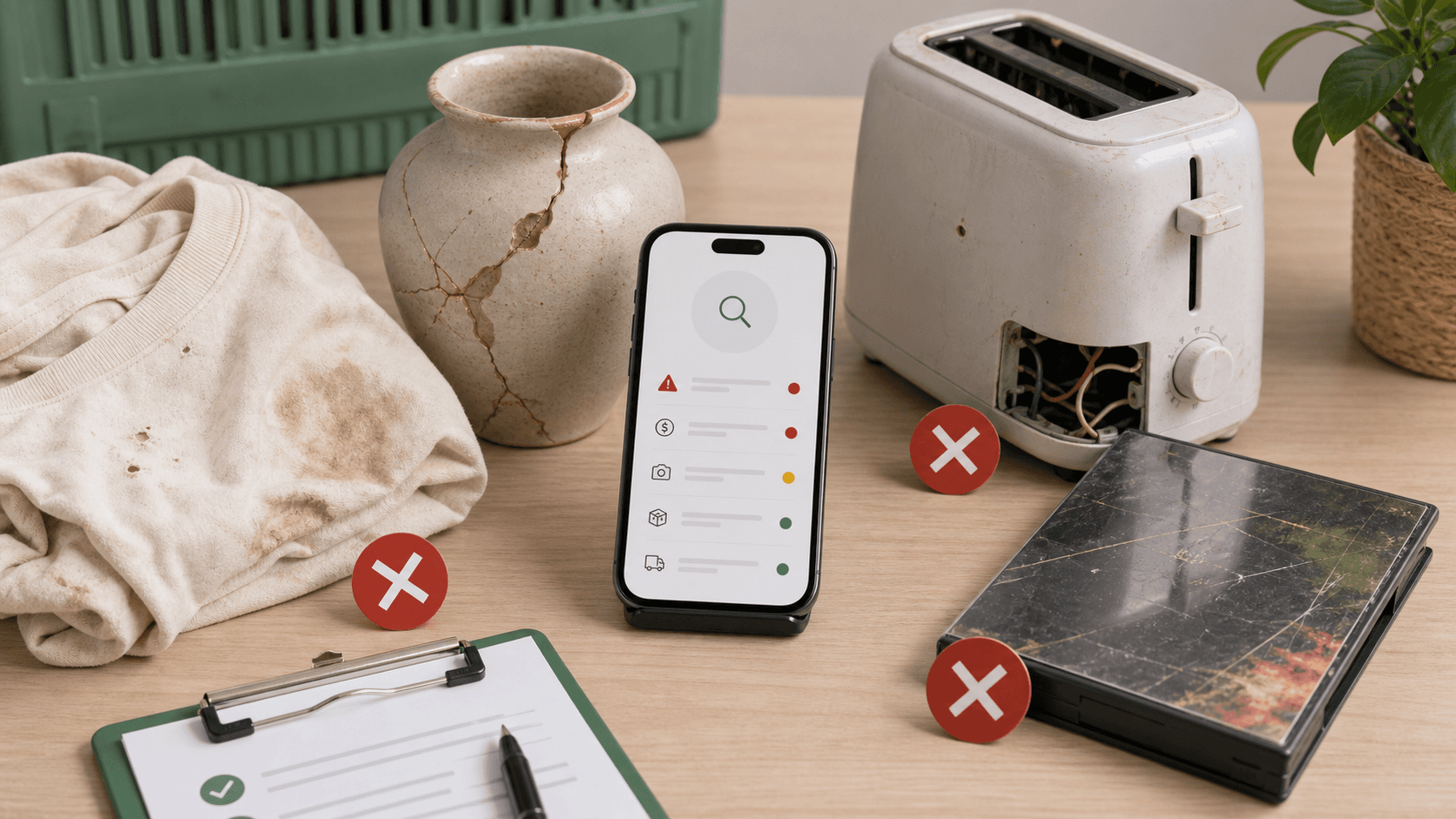
Stains, odour, dry rot, mould, cracked plastic, water damage, missing veneer, corrosion, and structural damage should all be treated as serious rather than cosmetic. The category-defining question is whether you can confidently price the repair and whether you would be comfortable disclosing the flaw in full. If either answer is no, pass, or buy only at a price low enough that being wrong costs nothing. Odour deserves particular emphasis because it is invisible in photographs, difficult to remove from textiles and leather, and one of the most common causes of returns — smoke and mildew especially. Brittle or yellowed plastic on vintage electronics and toys is another quiet trap: it looks superficial and then cracks during packing. Learn which repairs you can actually perform to a standard you would sell, and treat everything outside that list as a reason to walk away rather than a project.
- Smoke or mildew odour in textiles, leather, and upholstered items.
- Mould or water staining, particularly on paper, fabric, and wood.
- Dry rot in shoe soles and elastic — often invisible until they crumble.
- Brittle or yellowed plastic that cracks under handling.
- Corrosion in battery compartments on electronics and toys.
- Structural damage to furniture joints and frames.
Low Demand Items With High Asking Prices
Some categories are full of confident listings and empty of completed sales. This is the sell-through problem, and it is the most expensive mistake on this list because it does not announce itself: you buy at a price justified by asking prices, the item is genuinely worth that in theory, and it simply never sells. Meanwhile it occupies space, attention, and cash. The check is quick — look at completed sales rather than active listings, and form a rough view of how many sell against how many are listed. If you cannot find recent sold comps at all, that absence is information, not an inconvenience to work around. Either reduce your expected price substantially to reflect a long hold, or skip the item. A modest profit that turns over several times a year beats a theoretical profit sitting on a shelf.
Read next:Sold listings vs asking pricesResale profit calculator
Authentication-Risk Categories
Luxury bags, watches, sneakers, jewellery, and signed collectibles can be highly profitable, but counterfeit risk changes the arithmetic in a way that beginners consistently underestimate. If authentication is required before you can sell with confidence, its cost and its turnaround time belong in the buy decision, not in a later step. More importantly, a deal that only works if the item is genuine is not a deal until authenticity is established — it is a bet. Platforms have grown stricter about counterfeit listings, and the consequence of getting it wrong is not only a refund but potentially a restriction on your selling account. Buy in these categories when you either know the category well enough to assess it yourself, or when the price is low enough that a fake costs you nothing meaningful. Otherwise let it go; there will be another one.
- Include authentication cost and turnaround in the buy decision, not after.
- Treat "it's probably real" as a reason to pass, not a reason to proceed.
- Remember that a counterfeit listing can cost you the account, not just the sale.
- Learn one or two of these categories properly rather than dabbling in all of them.
Trend Items You Are Buying Late
There is a category of mistake that has nothing to do with condition or completeness: buying into a trend after it has peaked. Comps from three months ago look excellent, the item is genuinely selling at those prices in the historical record, and by the time your listing goes live the demand has moved on. This affects media-driven collectibles, viral kitchen gadgets, fashion revivals, and anything that appeared in a popular show. The defence is to look at the shape of the sales history rather than its average — check whether recent sales are holding, drifting down, or have stopped entirely, and weight the most recent evidence heaviest. Where a category is clearly spiking, either move quickly and price to sell now, or accept that you are holding a speculative position. Buying at the top of a spike and pricing from the spike's average is the reliable way to lose money on an item that was, briefly, genuinely valuable.
- Check whether recent sales are holding or declining, not just the average.
- Weight the most recent completed sales most heavily.
- Be wary of items featured in a current show, film, or viral video.
- If you buy into a spike, price to sell immediately rather than holding for more.
Use a Pass List
The most useful discipline in thrift sourcing is a written pass list built from your own past mistakes rather than from general advice. Everyone's list differs, because it reflects what you can test, what you can repair, what you can store, and what you have personally lost money on. Write down the brands that never sell for you, the categories you cannot test, the fragile items you dread packing, and the repairs you always intend to do and never finish. Read it before a sourcing trip. The point is not to shrink your buying but to stop re-learning the same lesson at full price, and to spend your limited time and cash in the categories where you actually have an edge. Scan with PriceSnap whenever you are genuinely uncertain about value — but let the pass list handle the decisions you have already made, so you do not have to make them again in an aisle under time pressure.
Read next:Scan before you buyThrifting guide
Related categories
FAQ
What Not to Buy at Thrift Stores: Items That Kill Resale Profit — FAQ
Straight answers about accuracy, platforms, and how PriceSnap fits your workflow.
What thrift items should resellers avoid?
Avoid items with poor condition, missing parts, high shipping cost, low demand, authenticity risk, untested electronics, odor, or margins that only work in a best-case sale.
Are bulky thrift items bad for resale?
Not always, but bulky items need strong local demand or enough value to justify shipping, packing materials, and damage risk.
Should I buy untested electronics?
Only when the price reflects the risk. Untested electronics should be treated as repair or parts inventory until proven working.
Can PriceSnap help me avoid bad thrift buys?
Yes. PriceSnap helps estimate value and confidence quickly, which makes it easier to pass when the numbers or condition do not work.