

6 min readBy PriceSnap Editorial TeamPublished
How to Spot Fake Designer Bags Before You Buy or Sell
Designer bags can be profitable thrift finds, but counterfeit risk changes the entire resale equation. A bag that looks valuable can become unsellable if the construction, materials, hardware, serial details, or seller story do not hold up. This guide shows practical red flags to check before you buy, list, or accept an offer.
AI summary
This guide explains how to spot fake designer bags by checking construction, stitching, leather, hardware, logo quality, interior labels, serial or date details, packaging, seller signals, and when to use professional authentication.
PriceSnap is a mobile app for iOS and Android.
Use the app while reading this guide to scan items, estimate resale value, check marketplace comp signals, and save finds to your collection.
Key takeaways
- No single photo detail proves a designer bag is real; authenticity is a pattern of evidence.
- Stitching, materials, hardware, logo quality, interior labels, smell, shape, and packaging all matter.
- Serial or date details can support authenticity, but they can also be copied by counterfeiters.
- Use PriceSnap for value context, then use professional authentication for high-value resale decisions.
Try alongside this guide — scan straight from your camera roll.
Start With the Whole Bag
Do not attempt to authenticate from one logo, one serial code, or one blurry photograph. Authentication is a weight-of-evidence judgement across many details at once: the overall shape and proportions, the structure and how the bag holds itself, the leather or canvas texture, the hardware, the stitching, the lining, the interior labels, the zipper pulls, the strap attachments, and the wear patterns. A genuine bag is consistent across all of these because it came off one production line with one set of standards. Counterfeits are typically strong in the areas that photograph well — the logo, the front face, the obvious hardware — and weak in the areas that are expensive to replicate, such as interior finishing, edge painting, and the way the bag sits when empty. Train yourself to look at the unglamorous parts first, since that is where the answer usually is.
- Overall silhouette and proportions when the bag is empty and unsupported.
- Interior finishing, lining fabric, and the neatness of internal seams.
- Edge paint and glazing, especially where straps meet the body.
- Hardware weight, finish, and how it ages relative to the leather.
- Consistency: genuine bags are uniformly good, fakes are uneven.
Inspect Stitching and Construction
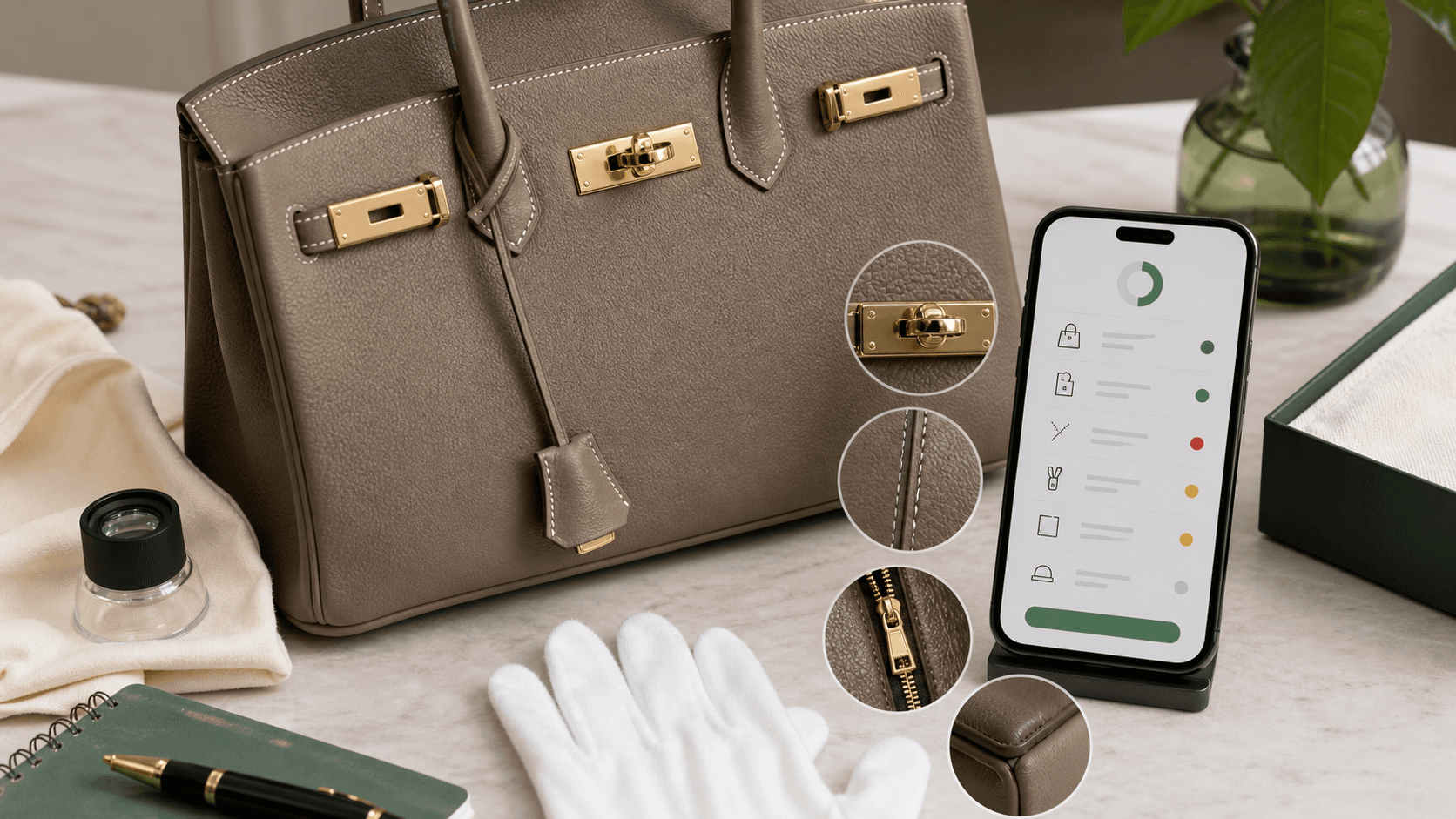
Stitching should be even, secure, and appropriate to the bag style, with consistent stitch count and spacing along a given seam. Watch for loose threads, crooked seams, uneven spacing, weak or cracked edge paint, poor glazing, sloppy corners, and misaligned panels — particularly where a pattern or logo print should line up across a seam. Construction quality is difficult to fake perfectly because it depends on material selection, pattern cutting, assembly, and finishing, each of which requires skilled labour. Pay particular attention to stress points: where handles attach, where a strap meets a D-ring, and the base corners, since these are reinforced carefully on genuine bags and frequently simplified on counterfeits. A useful habit is to compare the left and right sides of the same bag; asymmetry that a factory would have rejected is a strong signal.
- Even stitch count and spacing along each seam.
- Pattern or logo alignment across seams.
- Reinforcement at handle and strap attachment points.
- Clean, uncracked edge paint with no bleed onto the leather.
- Left-right symmetry across the same bag.
Check Materials and Smell
Leather, coated canvas, suede, and lining should feel consistent with the claimed brand and model, and material is one of the hardest things for a counterfeiter to get right at a price. Red flags include plastic-like stiffness, a chemical smell, peeling coating, thin hardware plating, flimsy lining, and materials that feel too light for the design — genuine bags in structured styles have a weight to them that comes from the density of the materials. Smell deserves its own mention because it is a surprisingly reliable and completely free test: genuine leather has a characteristic smell, while many counterfeits carry a strong chemical or glue odour from the adhesives and coatings used. Some vintage bags carry age and storage odour, which is different from a harsh chemical smell and should not be confused with it. If a bag smells wrong, take the rest of the inspection more slowly.
- Weight: structured genuine bags feel dense for their size.
- Chemical or glue odour rather than leather smell.
- Coating that peels, bubbles, or feels like plastic film.
- Lining fabric that is thin, shiny, or fraying at seams.
- Suede or nap that feels synthetic and uniform.
Study Hardware, Zippers, and Logos
Hardware should feel solid, align cleanly, and age consistently with the rest of the bag. Check zipper movement — a genuine zip runs smoothly under light pressure rather than catching — along with logo engraving quality, clasp function, screw heads, chain weight, rivets, and colour consistency across every metal component. Poor spacing in engraved text, shallow or uneven engraving, incorrect finish, and lightweight hardware are among the most common warning signs, and they are also among the most reliable, because good hardware is expensive to produce. Look at how hardware has worn: on a genuine used bag, plating wears at the contact points in a way that follows use, whereas counterfeit plating often flakes in patches unrelated to handling. Check that all hardware matches in tone; mixed finishes on a bag that should be uniform suggest replaced or mismatched parts.
- Zip runs smoothly under light pressure without catching.
- Engraving is crisp, evenly spaced, and correctly proportioned.
- All metal components match in tone and finish.
- Wear follows contact points rather than flaking in random patches.
- Screws, rivets, and feet are correctly seated and finished.
Understand Serial and Date Details
Serial numbers, date codes, authenticity cards, and interior labels help identify a bag, but they do not prove authenticity on their own — this is the most important thing to understand about them. Counterfeiters copy these details, and copying a code is far easier than replicating construction. A correct-looking serial number therefore raises your confidence only slightly, while an incorrect or impossible one is strong negative evidence. Use codes as supporting evidence alongside construction, materials, hardware, seller history, and professional review, and be aware that different houses use different systems that have changed over time, so a code format that is correct for one era is wrong for another. Note also that some genuine bags legitimately lack codes depending on their age and origin, so absence alone is not proof of anything.
- A correct code is weak positive evidence; an impossible one is strong negative evidence.
- Code formats change by era — check the format against the claimed period.
- Some genuine bags legitimately have no code.
- Authenticity cards are counterfeited as readily as bags.
- Never let a code override obvious construction problems.
Evaluate Packaging and Accessories
Dust bags, boxes, receipts, tags, cards, locks, keys, straps, and booklets increase buyer confidence, but accessories can be fake or mismatched just as easily as the bag itself, and a full set of accessories around a poor bag should raise suspicion rather than settle it. Check whether each accessory fits the bag's model, age, and condition story: a pristine dust bag with a heavily worn bag, or packaging from a different era than the bag claims, is an inconsistency worth pursuing. Dust bag fabric, printing, and drawstring quality all vary between genuine and counterfeit versions. A perfect receipt paired with a bag that has obvious construction problems tells you the receipt is the fake, not that the bag is genuine. Weigh accessories as one input among many, and let construction evidence take priority when they disagree.
- Does each accessory match the bag's model, era, and condition story?
- Dust bag fabric, print quality, and drawstring construction.
- Packaging that looks newer or older than the bag itself.
- A receipt cannot outweigh construction problems.
Watch the Seller Story
Secondhand buying is as much about source risk as object risk, and the seller's behaviour is evidence you can read for free. Be cautious with vague origin stories, pressure to buy quickly, refusal to provide extra photographs, prices far below market, stock photographs instead of the actual item, no return path, and missing close-ups of exactly the areas an authenticator would want. The last of these is the most telling: a seller who provides fifteen photographs but none of the interior label, the hardware engraving, or the base corners is usually not doing that by accident. Ask direct, specific questions and note how they are answered. A genuine private seller may not know much about authentication, but they will normally be willing to photograph whatever you ask for. Evasion is information.
- Refusal or reluctance to photograph specific areas on request.
- Stock photographs rather than the actual item.
- Pressure to decide quickly, or a price far below market.
- Vague provenance that changes when questioned.
- No return path and no willingness to allow authentication.
Common Myths Worth Discarding
Several widely repeated authentication tests are unreliable, and trusting them produces both false confidence and false alarms. The idea that genuine bags never have upside-down logos on the reverse is wrong for some models, which are cut from a single continuous piece of material. The belief that a serial number can be checked against a manufacturer database is generally false — most houses do not offer public verification. The claim that genuine bags always have perfectly aligned patterns ignores documented variation in certain models and eras. And the notion that a bag bought from a reputable-looking source must be genuine ignores that counterfeits enter legitimate resale channels regularly. Treat single-point tests with suspicion in both directions. Authentication is the accumulation of many consistent signals, and any rule that promises a one-glance answer is selling certainty that does not exist.
- "Upside-down logo means fake" — untrue for some single-piece constructions.
- "Check the serial against the brand's database" — most houses offer no public lookup.
- "Genuine bags always align perfectly" — documented variation exists by model and era.
- "It came from a reputable reseller so it's genuine" — counterfeits enter legitimate channels.
- Any single-glance test is overselling; authentication is cumulative.
Use Value Tools and Authentication Together
PriceSnap can help you estimate what a designer bag might be worth if it is authentic and in the stated condition. That is a genuinely useful thing to know, and it is a different question from whether the bag is real. Keep the two separate and run them in the right order: get a value estimate first, because that tells you whether professional authentication is economically worth commissioning, then authenticate before listing, buying, or accepting a serious offer. For high-value bags this sequence protects you in both directions — it stops you paying for authentication on a bag that was never worth much, and it stops you committing real money on a bag whose status is unresolved. Reputable third-party authentication services and specialist consignment houses both perform this function, and their fee is small against the exposure.
Read next:Designer bag resale value guideHow to sell a luxury bag
Related categories
FAQ
How to Spot Fake Designer Bags Before You Buy or Sell — FAQ
Straight answers about accuracy, platforms, and how PriceSnap fits your workflow.
How can I tell if a designer bag is fake?
Check the whole pattern: stitching, material quality, hardware, logo placement, interior labels, serial or date details, packaging, smell, shape, and seller credibility. Use professional authentication for high-value bags.
Can PriceSnap authenticate designer bags?
PriceSnap can help estimate value and flag risk signals, but it is not a professional authentication service. Expensive bags should be authenticated before resale.
Are serial numbers enough to prove a bag is real?
No. Serial, date, or authenticity details can be copied. They should support the rest of the evidence, not replace material and construction checks.
What is the biggest red flag when buying a designer bag secondhand?
The biggest red flag is a deal that depends on the bag being authentic while the seller cannot provide clear photos, provenance, or condition details.