

7 min readBy PriceSnap Editorial TeamPublished
How to Sell a Luxury Bag: Valuation, Channels, and Payout Math
Selling a luxury handbag is two decisions, not one. First you have to understand what the bag is genuinely worth in today's secondary market — which is rarely a fixed percentage of its retail price. Then you have to pick a selling channel, because the same bag can return very different amounts depending on whether you consign it, sell it yourself, accept an instant buyout, or send it to auction. This guide covers both, plus the safety and documentation steps that protect a high-value sale.
AI summary
A luxury bag's resale value depends on brand and model demand, condition, authenticity evidence, completeness, and current market timing — not on a fixed share of its original retail price. Sellers choose among four channel types: consignment (higher gross price, commission deducted, slower), peer-to-peer marketplaces (highest ceiling, most work and risk), instant buyout (fastest, lowest payout), and auction (best for rare or exotic pieces, variable outcome). Compare net payout after commission, authentication, shipping, insurance, and any repair cost rather than headline price, and never accept off-platform payment for a high-value bag.
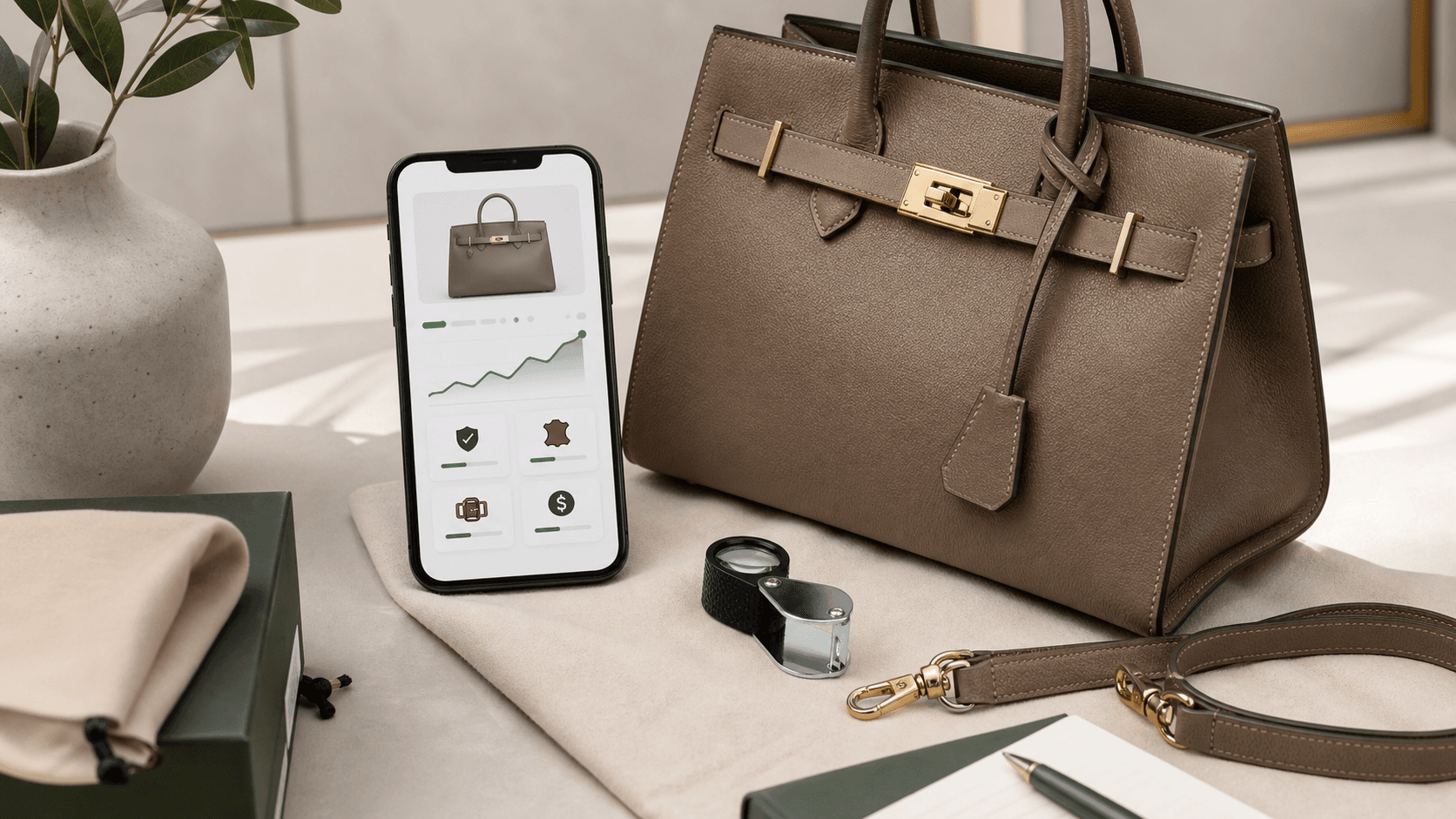
PriceSnap is a mobile app for iOS and Android.
Use the app while reading this guide to scan items, estimate resale value, check marketplace comp signals, and save finds to your collection.
Key takeaways
- Retail price is a weak predictor of resale value; model demand and condition matter far more.
- Compare channels on net payout after commission, authentication, shipping, insurance, and repairs — not on advertised sale price.
- Completeness matters: dust bag, box, receipt, authenticity card where applicable, straps, and clochette all move the number.
- Interior corner wear, handle darkening, and odor are the condition faults that most reliably cut offers.
- Get authentication settled before listing a high-value bag; a rejected bag mid-sale costs time and credibility.
- For anything expensive, never leave the platform's payment and protection system, however convincing the buyer.
Try alongside this guide — scan straight from your camera roll.
Quick Answer: Two Decisions, Priced Separately
The value question and the channel question are independent, and mixing them is the most common selling mistake. First establish an evidence-based range for your specific bag from recent completed sales of the same model, size, material, hardware finish, and condition. Only then choose where to sell, comparing what each channel actually pays you after its cut. A bag with a realistic market value can still produce a disappointing result through the wrong channel, and a fast buyout offer can look generous until you see what the same bag closed for elsewhere last month.
Why Retail Price Is a Poor Starting Point
Sellers often anchor on what they paid, but the secondary market prices demand, not history. Some house classics sell close to or occasionally above their earlier retail price because the house raised prices repeatedly or discontinued the model. Others — particularly seasonal colors, logo-heavy trend pieces, and diffusion lines — settle well below retail regardless of condition. Two bags bought the same day at the same price can diverge sharply years later. Use retail only as background context, and let matched recent sales set your expectation.
The Five Factors That Actually Set the Number
Model demand comes first: a specific style, size, and era either has active buyers right now or it does not. Condition comes second, and it is judged in detail rather than as a single word. Authenticity evidence comes third — a bag that can be verified quickly sells faster and higher than an identical bag that cannot. Completeness is fourth: straps, clochettes, padlocks, keys, dust bag, box, and receipt each reduce buyer risk. Timing is fifth, because demand moves with seasons, house price changes, celebrity and runway attention, and the supply of similar listings currently competing with yours.
| Factor | What it turns on |
|---|---|
| Model demand | Whether this style, size, and era has active buyers now |
| Condition | Judged in detail, not as a single word |
| Authenticity evidence | How quickly a buyer can be satisfied it is genuine |
| Completeness | Straps, clochettes, padlocks, keys, dust bag, box, receipt |
| Channel | What the route to sale takes out of the headline price |
Grade the Condition Honestly Before Anyone Else Does
Work through the bag systematically and photograph what you find. Check the four bottom corners and piping for abrasion, the handles and strap for darkening, cracking, or stickiness, the interior lining for stains, pen marks, and residue, the hardware for plating loss and scratches, the zipper for smooth travel, the base for sagging or shape loss, and the whole bag for odor, which is one of the hardest faults to sell through. Structural issues such as a broken strap attachment, delaminating coating, or a damaged frame affect price far more than light surface wear. Disclose everything: an undisclosed fault discovered at authentication turns a completed sale into a return.
- Four bottom corners and the piping, for abrasion.
- Handles and strap: darkening, cracking, stickiness.
- Interior lining: stains, pen marks, residue.
- Hardware: plating loss, scratches, zipper travel.
- Base and overall shape: sagging, creasing, structure loss.
- Odour — which no photograph shows and every buyer notices.
Settle Authentication Before You List
Every serious luxury channel authenticates, and it is better to know the outcome before a buyer is waiting. Gather what supports the bag's identity — interior stamps, date or serial details where the house uses them, hardware engravings, stitching and edge finishing, and any original receipt or repair record — and photograph them clearly. If you inherited the bag or bought it secondhand yourself and have doubts, resolve them first through the platform's own process or an independent authentication service. Two cautions: a photo scan or value app can estimate identity and price but does not certify authenticity, and a bag that fails authentication mid-sale costs you the sale, the shipping, and often the account standing.
Channel One: Consignment
Consignment platforms and boutiques take the bag, authenticate it, photograph it, list it, handle buyer questions, and pay you after it sells, minus a commission. The commission structure is the point to interrogate: it commonly varies by brand, by sale price, and sometimes by how long the item has been listed, and some programs offer a higher rate in exchange for accepting a lower listing price or a faster markdown schedule. Ask what happens if the bag does not sell, who controls price reductions, how long the consignment period runs, who pays return shipping, and how the item is insured while in their possession. Consignment usually wins when the bag is valuable, you are not in a hurry, and you do not want to manage buyers.
Channel Two: Peer-to-Peer Marketplaces
Selling it yourself on a general or fashion-focused marketplace keeps the largest share of the sale price and gives you full control over pricing and timing. In exchange you do all the work: research, photography, description writing, question answering, price negotiation, packing, shipping, and dispute handling. You also carry the fraud exposure, which is meaningfully higher on expensive bags — common patterns include a buyer claiming a different item arrived, requesting off-platform payment, or filing a not-as-described dispute after use. This channel suits sellers who already list regularly, photograph well, and understand the platform's seller protection rules before they need them.
Channel Three: Instant Buyout
Buyout services quote a price, take the bag, and pay quickly, absorbing all resale risk themselves. That risk transfer is exactly why the offer sits below what the bag would fetch on consignment or peer-to-peer: the buyer needs a margin to cover authentication, refurbishment, holding time, and the possibility the bag sells slowly. Buyout is a legitimate choice when you need certainty or speed, when the bag is a lower-value or hard-to-move model, or when you simply do not want the process. Before accepting, get at least two quotes and compare them against recent completed sales for the same model, so you know precisely what the convenience is costing you.
Channel Four: Auction
Auction houses make sense for a narrow band of bags: genuinely rare models, exotic materials, limited editions, collaborations, and pieces with documented provenance. The process is slower — consignment agreements, cataloguing, and scheduled sale dates — and the outcome is variable, since a thin bidder pool on the day can produce a weak result. Costs to clarify upfront include the seller's commission, photography and cataloguing charges, insurance, and any unsold-lot fee. Note also that exotic-skin bags face import, export, and documentation rules that vary by country and can restrict who is legally able to buy them, which narrows the market and belongs in your pricing expectation.
Compare Net Payout, Not Headline Price
Build a simple comparison before choosing. For each channel write down the realistic sale price, then subtract commission or platform fees, payment processing, authentication charges, shipping both ways where applicable, insurance, and any repair or cleaning spend. Add an estimate for how many weeks until you actually receive the money, and for the probability the bag does not sell at all in that channel. A consignment sale at a higher gross can land below a self-managed sale at a lower gross, or above it, depending entirely on those deductions. Do this arithmetic once and it will pick the channel for you.
| Line | Note |
|---|---|
| Realistic sale price | From matched completed sales, not retail |
| Commission or platform fees | Often varies by brand, price, and listing age |
| Payment processing | Separate from commission on most platforms |
| Authentication charges | Sometimes deducted, sometimes paid upfront |
| Shipping both ways, and insurance | Confirm the carrier covers luxury goods |
| Repair or cleaning spend | Only where it demonstrably raises the tier |
| Weeks until you are paid | Certainty has real value; price it |
| Probability it does not sell | The line most often left out |
Photograph and Describe It Like a Buyer Would Inspect It
Luxury buyers are risk-averse, and the listing has to answer their objections before they ask. Shoot in bright, neutral, indirect light against a plain background: front, back, both sides, base, all four corners, interior, interior stamp, date or serial detail, hardware engraving, zipper pulls, strap attachment points, and a close image of every flaw you identified. Include the packaging and every accessory in one frame so completeness is obvious. Write the description with the exact model name, size, material, hardware color, and measurements, then list the condition faults plainly. Honest flaw photos reduce returns and disputes, which is worth more than the small number of buyers they scare off.
Protect the Transaction
Keep the money inside the platform. The most common loss on a high-value bag is not underpricing — it is a seller who agreed to a direct transfer, a payment app, or a shipment to a different address as a favor. Ship with tracking, signature on delivery, and insurance for the full sale value, and confirm the carrier actually covers luxury goods, since several exclude them. Record video of the bag and the packing process before you seal the box, keep the serial or date code images, and retain proof of purchase and any authentication paperwork until the return window has closed. If a buyer's story requires you to break a platform rule, that is the tell.
- Keep the payment inside the platform — always.
- Refuse direct transfers, payment apps, and shipment to a different address.
- Ship with tracking, signature on delivery, and full-value insurance.
- Confirm the carrier does not exclude luxury goods.
- Record the bag's condition and packing before dispatch.
Read next:How to spot fake designer bags
Use a Fast Value Check to Triage Your Closet
If you are deciding which bags to sell rather than pricing a single known piece, start with speed. Photograph each bag and scan it with PriceSnap to get a directional identity and value range in seconds, then sort them into three groups: worth listing now, worth holding, and not worth the effort. Take the top group into real research — matched recent sold results, channel comparison, and authentication planning. That keeps deep work on the bags that justify it, and it stops you spending an afternoon researching a piece whose realistic net payout would not cover the shipping. Treat the scan as a first read, not an appraisal, and verify anything expensive before you accept an offer.
Read next:Designer bag resale value guideHow PriceSnap estimates resale value
Related categories
Continue your research
- Sold Price vs Asking Price: The $100 Thrift Find That Might Be Worth $30An asking price is what a seller requests; a sold price records a completed transaction. Estimate resale value from recent sales matched for model, condition, completeness and market, then subtract costs. An active listing alone does not establish value, and even a sold comp does not guarantee your next sale.
- Spot Fake Designer Items When Thrifting: 7 Checks Before You BuyScreen a thrifted designer item by checking model consistency, labels, construction, hardware, material, identifiers and provenance together. No single detail proves authenticity. A photo value estimate is not authentication; unresolved luxury items need a qualified specialist before being represented as genuine.
- Best Reselling Platforms in the USA: Fees and What to Sell (2026)This June 2026 guide compares eBay, Poshmark, Mercari, Depop, Etsy, and local marketplace selling in the United States by seller fees, buyer intent, product fit, shipping friction, promotion costs, and likely net profit.
- Designer Bag Resale Value Guide: How to Price Luxury HandbagsThis guide explains designer handbag valuation using brand, model, size, leather, hardware, color, condition, accessories, authenticity signals, and current secondary-market comps.
FAQ
How to Sell a Luxury Bag: Valuation, Channels, and Payout Math — FAQ
Straight answers about accuracy, platforms, and how PriceSnap fits your workflow.
How much is my designer bag worth?
Start from recent completed sales of the same model, size, material, hardware, and condition — not from active asking prices or the original retail price. Adjust down for corner wear, handle darkening, odor, missing accessories, or absent proof of purchase, and adjust up for a current, in-demand model in excellent condition with full packaging. A photo scan can give you a directional range in seconds, but confirm anything expensive against matched sold comps.
Is consignment better than selling a bag myself?
It depends on what your time and risk tolerance are worth. Consignment handles authentication, photography, listing, buyer questions, and fraud risk, and typically reaches buyers who are willing to pay more for a vetted item — but the commission comes out of your proceeds and the sale can take weeks or months. Selling peer-to-peer has the highest ceiling and the lowest fees, but you absorb all the work and all the scam risk.
Do I need the box, dust bag, and receipt to sell a luxury bag?
You can sell without them, but they help. Original packaging and proof of purchase reduce a buyer's perceived risk, which typically shows up as a higher price and a faster sale. Missing accessories such as a shoulder strap, clochette, keys, or padlock reduce value more than missing packaging, because they are functional parts of the bag.
Should I repair or clean a bag before selling it?
Do the cheap, low-risk things: empty and air the interior, wipe loose dirt, and photograph honestly. Be cautious with restoration. Professional repairs sometimes pay for themselves on high-value bags with a specific fixable fault, but many buyers and platforms treat aftermarket work and non-original replacement parts as a negative. Get a quote first and compare it against the realistic increase in sale price.
How do I avoid getting scammed when selling an expensive bag?
Keep the entire transaction inside a reputable platform's payment and protection system. Refuse requests to move to direct bank transfer, gift cards, or a payment app "to save fees". Ship with tracking, signature, and adequate insurance. Photograph and video the bag and the packing process before sealing it, and keep the serial or date code image in your records for any dispute.
Which luxury bags hold value best?
Broadly, established house classics in neutral colors and durable materials retain value more consistently than seasonal, heavily branded, or trend-driven styles. Even so, demand shifts: a discontinued model can rise while a current one softens, and exotic materials carry legal and shipping restrictions that narrow the buyer pool. Check recent sold results for the exact model rather than relying on general reputation.