

Sneaker Resale Value Guide: How to Price Used and Collectible Sneakers
Sneaker value changes with model, colorway, size, condition, box status, release supply, and buyer demand. This guide explains how to price used and collectible sneakers without relying on hype alone.
5 min readBy PriceSnap Editorial TeamPublished
AI summary
This guide explains sneaker valuation using exact model and colorway, size, condition, box and accessories, authenticity risk, release scarcity, sell-through, and recent comparable sales.
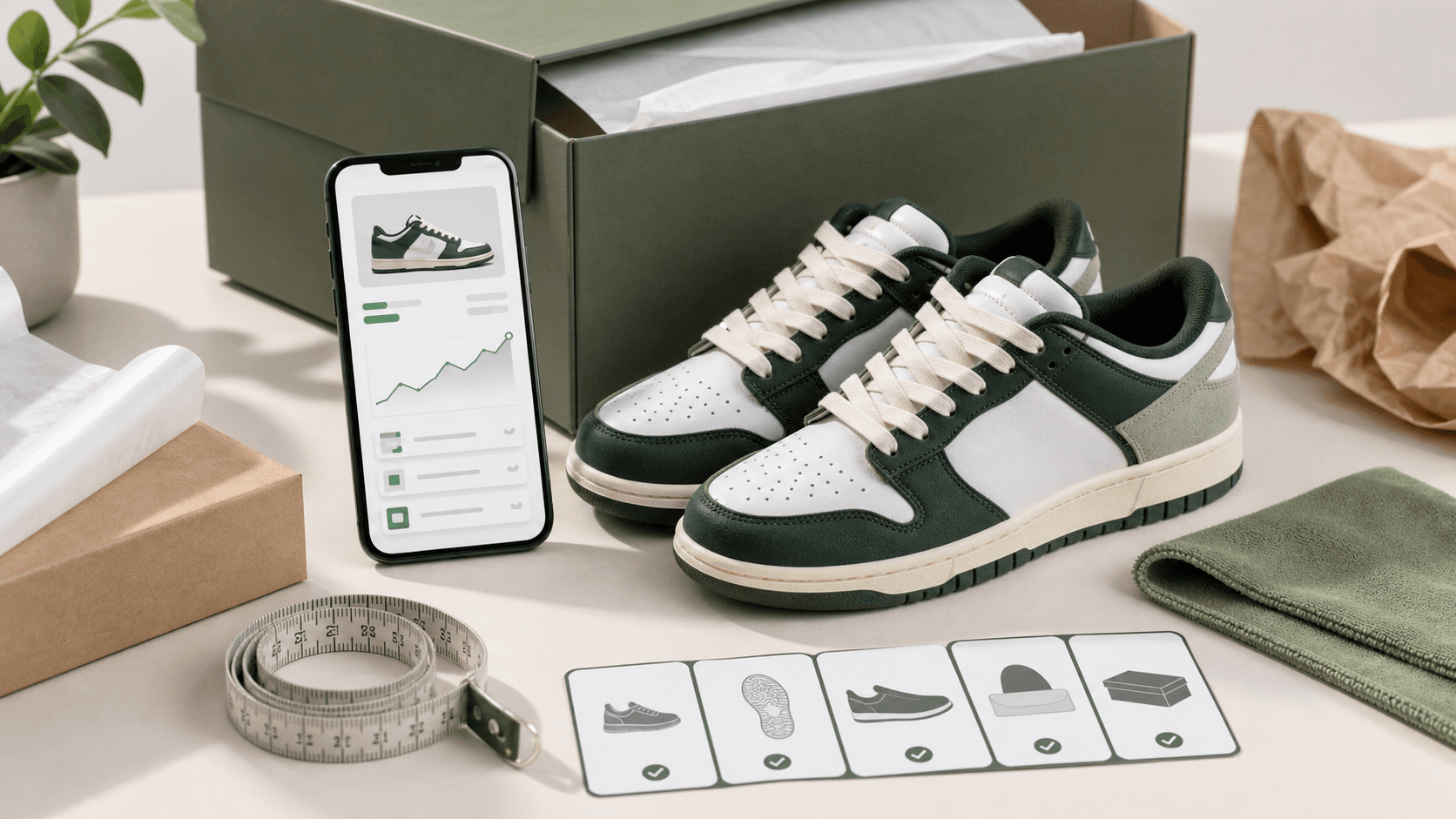
PriceSnap is a mobile app for iOS and Android.
Use the app while reading this guide to scan items, estimate resale value, check marketplace comp signals, and save finds to your collection.
Key takeaways
- Exact model, colorway, size, and release year matter before any sneaker value comparison.
- Used sneaker value depends heavily on outsole wear, creasing, stains, odor, heel drag, and box status.
- Deadstock and lightly worn pairs should be priced differently from heavily worn pairs.
- PriceSnap can scan sneakers for a fast starting estimate, but high-value pairs may still need authentication.
Try alongside this guide — scan straight from your camera roll.
Identify the Exact Sneaker First
Do not price sneakers by brand name alone. You need the model, the colourway, the size, the release year, the SKU or style code if you can find it, and whether the pair is a special edition, a collaboration, a restock, or a general release. Two pairs that look nearly identical in a photograph can occupy entirely different demand bands, because sneaker value is driven by release supply far more than by materials or construction. The style code is the fastest route to certainty: it is printed on the size tag inside the shoe, usually on the tongue label or under the collar, and it identifies the exact model and colourway combination. A restock of a previously scarce pair typically trades well below the original release, and a general release in a popular silhouette is not the same product as a limited collaboration in that silhouette. Establish which one you are holding before you look at any price.
- Style code or SKU from the size tag — the single most reliable identifier.
- Model and silhouette, named as the brand names it.
- Colourway, using the official colour name where one exists.
- Size, including the region the size is expressed in.
- Release type: general release, limited, collaboration, or restock.
- Release year, which distinguishes original runs from retros.
Read next:Sneaker value checker
Condition Signals Buyers Check
Used sneaker buyers inspect toe-box creasing, outsole wear, heel drag, midsole yellowing, stains, odour, liner tears, lace condition, and whether the original insoles are present. They inspect in that order because creasing and outsole wear are the fastest read on how much a pair has been worn. Two condition issues deserve particular attention. Midsole yellowing affects older pairs regardless of how carefully they were stored, since it is oxidation rather than dirt, and it cannot be reliably reversed. Sole separation and crumbling — where aged adhesive or foam breaks down — renders a pair unwearable and effectively unsellable, and it can appear on pairs that have barely been worn at all. Photograph both shoes, the soles, the heels, the toe boxes, the size tags, and every flaw before you price. Buyers who discover damage after purchase return the shoes; buyers who see it in the listing simply price it in.
| Term | What it means |
|---|---|
| Deadstock (DS) | Unworn, as it left the factory, normally with the original box |
| Very near deadstock (VNDS) | Worn once or twice with no meaningful wear |
| Used | Visible wear; condition described in detail |
| Beaters | Heavy wear; value is in wearing them, not collecting |
| Sole separation | Adhesive or foam failure — usually unsellable as wearable |
Box, Accessories, and Authenticity
Original box, extra laces, receipts, hang tags, and authentication paperwork all increase buyer confidence and therefore resale value. A missing box does not make a pair worthless, but it narrows the buyer pool, and among collectors it narrows it sharply — for a deadstock pair the box is close to essential, since a collector is buying the complete release. Check that the box label matches the shoes inside; mismatched boxes are common in thrift and consignment channels and raise immediate questions. Authenticity risk belongs in your buy decision rather than in a later step. Counterfeit sneakers have become sophisticated enough that photographs alone are unreliable, particularly on the most valuable models, which are also the most heavily faked. Several marketplaces now authenticate in the middle of the transaction, which removes much of this risk for both sides at the cost of a fee — often the right trade on an expensive pair.
- Original box with a label matching the shoes inside.
- Spare laces, hang tags, and any extras included at release.
- Original insoles — frequently replaced, and buyers check.
- Receipt or proof of purchase where it exists.
- For expensive pairs, consider a marketplace that authenticates in-transaction.
Use Sold Comps by Size and Condition
Sneaker prices are size-specific in a way that few other categories are, and ignoring this is the most common pricing error in the category. The same pair in a very common men's size and in an unusually large or small size can trade at meaningfully different levels, because demand is distributed across sizes unevenly while supply is not. Compare sales for the same size or an adjacent one, then adjust for condition. Do not compare a clean worn pair against a deadstock pair and expect the same number; those are different products. Recent sales beat current asking prices because they show what buyers actually did rather than what sellers hope for, and sneaker asking prices are unusually optimistic given how much of the market is speculative. Where a pair released recently, be aware that prices often move sharply in the first weeks after release before settling.
Read next:Sold listings vs asking prices
Cleaning and Preparation Pay for Themselves
Sneakers are one of the few resale categories where modest preparation reliably changes the sale price, because so much of the buyer's judgement rests on how the pair photographs. A careful clean of the uppers, midsoles, and outsoles, fresh laces where the originals are grey, and removal of insole odour will usually move a pair up a perceived condition tier for very little cost. Work within the limits of the material: suede and nubuck need brushing rather than water, knit uppers mark easily, and aggressive solvents damage paint and glue. Do not attempt to disguise damage. Repainting midsoles, hiding sole separation, or masking odour rather than removing it produces returns and negative feedback, and buyers in this category are experienced at spotting it. Clean honestly, photograph after cleaning in natural light, and describe what you did.
- Match the method to the material — suede and knit need different treatment from leather.
- Replace grey or frayed laces; keep the originals if they are part of the release.
- Treat odour at the source rather than masking it.
- Photograph after cleaning, in daylight, against a plain background.
- Never repaint, re-glue, or disguise damage without disclosing it.
When a Sneaker Is a Good Flip
A good sneaker flip has enough spread between your all-in cost and a realistic resale figure after cleaning, fees, shipping, and any authentication. Work that arithmetic before you buy rather than after, and use a realistic resale figure rather than the best result you have ever seen for the model. Avoid pairs with heavy odour, sole separation, severe heel drag, missing size tags, or authenticity uncertainty unless the price already fully reflects that risk — and note that a missing size tag is worse than it looks, because it removes your ability to prove the size and the style code. Be honest with yourself about hold time too. A pair that will sell in a fortnight at a modest margin is usually a better use of cash than a scarcer pair that may sell in six months at a larger one, particularly early on when your capital is limited.
Read next:Resale profit calculatorWhat not to buy at thrift stores
How to Scan Sneakers With PriceSnap
For the best scan, photograph the side profile of both shoes, the tongue or size tag showing the style code, the outsole, the heel, and the box label if you have the box. The size-tag photograph is the one that most improves the answer, because the style code identifies the exact model and colourway that the rest of the pricing depends on. Add a short note with the size and your honest condition assessment. PriceSnap will use those signals to return a directional range that tells you whether a pair is worth cleaning, listing individually, or passing on entirely — useful in an aisle, where the alternative is guessing from the silhouette alone.
Read next:How PriceSnap estimates resale value
Related categories
FAQ
Sneaker Resale Value Guide: How to Price Used and Collectible Sneakers — FAQ
Straight answers about accuracy, platforms, and how PriceSnap fits your workflow.
How do I find the resale value of sneakers?
Identify the exact model, colorway, size, release year, condition, and box status, then compare recent sold comps for the same pair.
Does sneaker size affect resale value?
Yes. Common buyer sizes often have stronger liquidity, while very small or very large sizes can price differently depending on demand.
How much does condition affect used sneaker value?
Condition can change value dramatically. Heel drag, outsole wear, creasing, stains, odor, missing insoles, and damaged boxes all reduce resale value.
Can PriceSnap scan sneakers?
Yes. PriceSnap can scan sneaker photos and return a directional resale value estimate using visible model and condition cues.