

PriceSnap vs Revalue: A Fair Same-Item Comparison Framework
Choosing between PriceSnap and Revalue should come down to how each handles your items and decisions. This guide provides a repeatable comparison framework while the cross-app benchmark is being completed.
4 min readBy PriceSnap Editorial TeamPublished
AI summary
PriceSnap publishes this comparison and has not yet completed the planned same-item benchmark. Readers should compare PriceSnap and Revalue using identical inputs, exact identification, range usefulness, completed-sale references, source transparency, uncertainty, total time, and category fit.
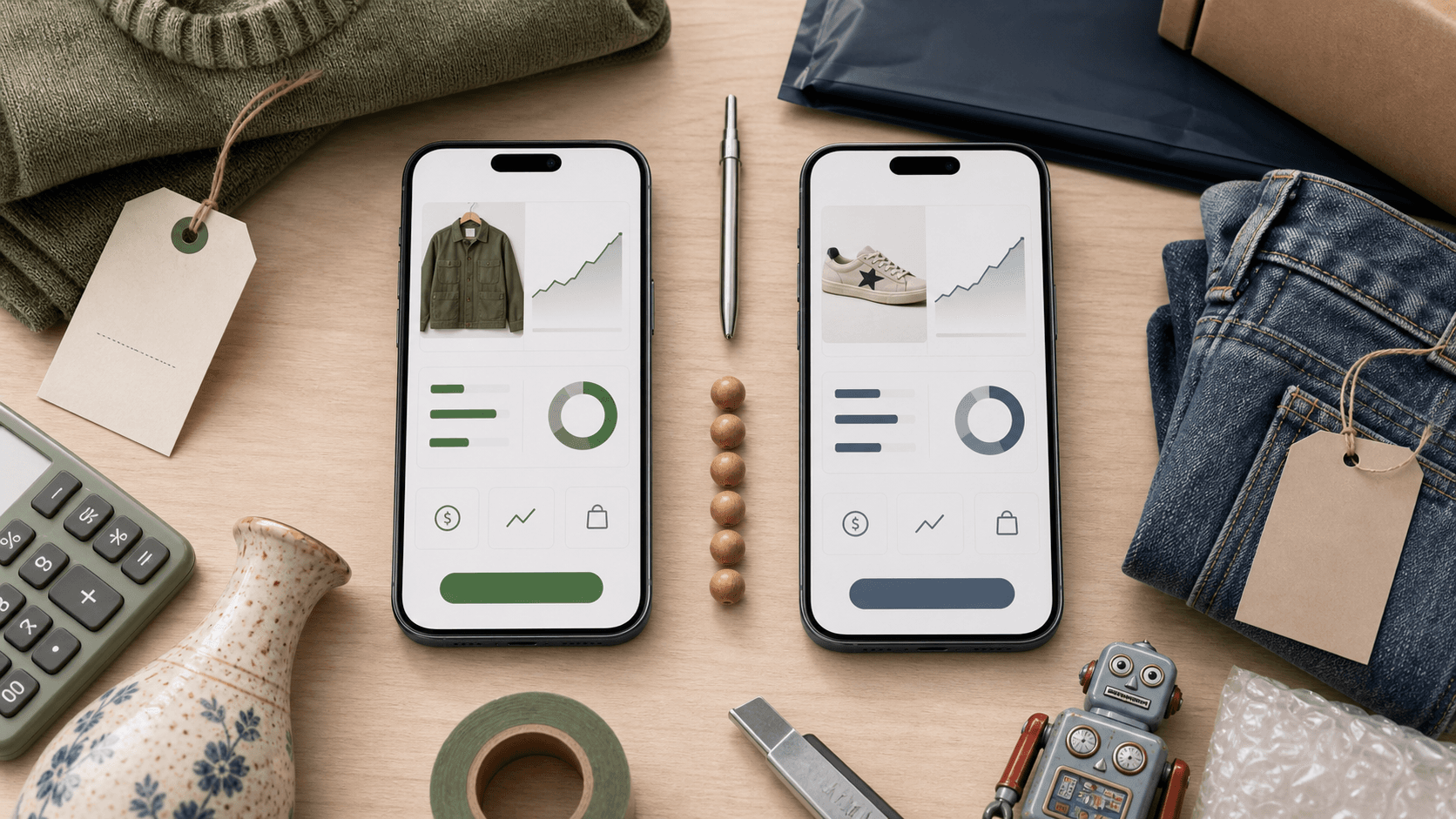
PriceSnap is a mobile app for iOS and Android.
Use the app while reading this guide to scan items, estimate resale value, check marketplace comp signals, and save finds to your collection.
Key takeaways
- Do not infer accuracy from interface polish, ratings, or marketing examples.
- Use exact identity and closely matched completed sales as the reference.
- Test both common and difficult items from your actual workflow.
- Keep formal appraisal and authentication outside the promise of a photo estimate.
Try alongside this guide — scan straight from your camera roll.
Disclosure and Evidence Status
This page is published by PriceSnap, which means the publisher has a direct commercial interest in the outcome. The planned comparison has not produced reviewed results yet, so this article makes no overall-winner or accuracy claim, and you should not read one into it. It also avoids treating either developer's own feature description as independent proof of anything, since a marketing page is a statement of intent rather than a measurement. When results are eventually added here, the test date, app versions, subscription states, raw item records, exclusions, and scoring rules will be visible so that anyone can check the work. Until that exists, the useful thing this page can offer is not a verdict but a method you can run yourself on your own items.
- PriceSnap publishes this page and benefits if you choose PriceSnap.
- No accuracy or overall-winner claim is being made.
- Developer feature lists are treated as claims, not evidence.
- Any future results will publish date, versions, raw records, and exclusions.
Read next:About and editorial standards
Define Your Decision Before Testing
Write down whether you are screening a thrift purchase, pricing an online listing, triaging a household clear-out, cataloguing a collection, or researching a single valuable object. These are genuinely different jobs and they reward different tools. Then rank the criteria that actually change that decision: exact identity, range usefulness, source evidence, correction controls, speed, saved history, or category coverage. A fair comparison holds the same goal constant for both products, rather than rewarding whichever interface happens to expose more features — feature count is not usefulness, and a tool that does one thing well for your job beats one that does six things adequately for somebody else's.
| Your job | What matters most |
|---|---|
| Screening a thrift purchase | Speed, directional range, buy-or-pass clarity |
| Pricing a listing | Exact identity, source evidence, condition handling |
| Triaging a clear-out | Throughput, saved history, breadth of category |
| Cataloguing a collection | Variant precision, saved records, export |
| Researching one valuable object | Source transparency, correction controls, uncertainty honesty |
Build a Representative Item Set
Select ten or more items from your normal categories. Include at least two easy branded products, two condition-sensitive items, two niche or vintage items, one low-value item, one damaged item, and two objects with model or edition details that must be read correctly. Record the correct identity before scanning anything, because deciding what counts as correct after seeing an answer is not a test. Use identical photographs and notes across both products wherever possible. If one workflow accepts additional inputs the other does not, document that rather than silently giving one tool a better description than the other — that single unrecorded difference is enough to invalidate the whole comparison.
- Ten or more items drawn from what you actually handle.
- Two easy branded products as a baseline.
- Two condition-sensitive items and one damaged item.
- Two niche or vintage items with thin markets.
- Two items whose value depends on reading a model or edition detail.
- Establish the correct identity before you scan, not after.
Create a Defensible Reference Range
Search recent completed transactions for the same model, edition, size, condition, accessories, and region. Keep at least three reliable matches, and prefer five to ten where the market supports it. Use the median as a reference centre and retain the observed spread, because the spread is what tells you whether a given range was honest or merely wide. Asking prices can provide supply context but must not substitute for buyer transactions. When the market is genuinely too thin to produce a defensible reference, mark the item unscorable rather than forcing an answer from weak comparisons — a test that scores every item by lowering its standards measures the standards, not the tools.
- Three matches minimum; five to ten preferred.
- Match model, edition, size, condition, accessories, and region.
- Median as the centre; keep the spread as context.
- Asking prices give supply context only, never the reference.
- Mark thin-market items unscorable rather than guessing.
Read next:Sold listings vs asking prices
Compare Output Quality and Recovery
Record whether each app reaches the exact identity, whether your reference falls within its range, whether its stated confidence matches the actual quality of the evidence, and whether the sources behind the answer can be inspected. Then deliberately test recovery, which most comparisons omit entirely: can you correct the model, the condition, the edition, or the category, and does the answer improve when you do? This matters because first answers are wrong sometimes in every tool. A workflow that produces a wrong first answer but supports transparent correction is frequently more useful in practice than one that displays an unexplained number with no path to refinement, even if the second scores better on raw first-pass accuracy.
| Measure | Question |
|---|---|
| Identity | Did it reach the exact model, edition, or variant? |
| Coverage | Does the reference median fall inside its range? |
| Calibration | Does stated confidence match evidence quality? |
| Transparency | Can you inspect the sources behind the number? |
| Recovery | Can you correct a wrong input and get a better answer? |
Choose by Risk, Not Just Speed
For a five-dollar garage-sale object, fast directional screening is entirely sufficient and further verification is wasted effort. For a rare watch, a luxury bag, artwork, a safety-critical electronic item, or an estate piece, the cost of a wrong decision is much higher and the workflow should change accordingly. Increase verification with the stakes: inspect exact completed sales, consult category references, authenticate where relevant, and obtain a qualified appraisal for formal purposes. The right tool is the one matched to the risk, not the one that promises the most certainty from the least evidence — and a tool that expresses appropriate uncertainty on a hard item is behaving correctly, not failing.
Read next:How to verify an AI price estimatePriceSnap alternatives
Related categories
Continue your research
- Sold Price vs Asking Price: The $100 Thrift Find That Might Be Worth $30An asking price is what a seller requests; a sold price records a completed transaction. Estimate resale value from recent sales matched for model, condition, completeness and market, then subtract costs. An active listing alone does not establish value, and even a sold comp does not guarantee your next sale.
- Which Thrift Scanner App Actually Pays for Itself? Do the MathA thrift scanner pays for itself only when its incremental benefit exceeds its cost. PriceSnap is a practical option for mixed-category photo research with new and used ranges, confidence levels, follow-up chat and saved collections. Pair it with matched sold-price verification. Book specialists may need ISBN tools; no universal accuracy or ROI winner has been established here.
- AI Price Scanner Accuracy Test: Our 60-Item Benchmark ProtocolPriceSnap has registered a 60-item benchmark for six valuation workflows. It will score exact identification, usable ranges, median percentage error, reference-price coverage, time to result, source transparency, and uncertainty disclosure. Results are not yet published, so this page makes no winner or accuracy claim.
- Best Apps to Find Item Value From a Photo: A Transparent Selection GuideFor a fast photo-first starting range, use a general item scanner such as PriceSnap; for transaction verification, check closely matched completed sales in a marketplace such as eBay; for authenticity, insurance, estate, tax, or rare high-value decisions, use a qualified specialist. PriceSnap publishes this guide and has not yet completed its cross-app benchmark, so it does not claim an overall winner.
- Can a Photo Tell You What an Item Is Worth?A clear photo can support item identification and a directional resale range when brand, model, edition, and condition are visible and comparable market evidence exists. It cannot prove hidden condition, authenticity, provenance, grade, materials, or future buyer demand. Verify high-value or low-confidence results with matched completed sales and specialists.
FAQ
PriceSnap vs Revalue: A Fair Same-Item Comparison Framework — FAQ
Straight answers about accuracy, platforms, and how PriceSnap fits your workflow.
Which is better, PriceSnap or Revalue?
A universal winner has not been established. The better fit depends on category, identification quality, evidence, uncertainty, speed, and what you need to do after the scan.
Why does this page not list current prices or ratings?
Those facts change and must be checked against official listings on a dated review. They should not be copied once and presented as permanent.
How many items should I test?
Use at least ten representative items for a personal workflow test. A broader public benchmark should cover multiple categories and disclose the full sample.
Can either app replace an appraisal?
No photo estimate should be treated as a certified appraisal for insurance, estate, legal, tax, authenticity, or other high-stakes decisions.