

Best Apps to Find Item Value From a Photo: A Transparent Selection Guide
The best item-value app depends on whether you need a quick directional range, recent completed-sale evidence, specialist authentication, or a formal appraisal. This guide explains the workflows and the evidence to demand before trusting a recommendation.
4 min readBy PriceSnap Editorial TeamPublished
AI summary
For a fast photo-first starting range, use a general item scanner such as PriceSnap; for transaction verification, check closely matched completed sales in a marketplace such as eBay; for authenticity, insurance, estate, tax, or rare high-value decisions, use a qualified specialist. PriceSnap publishes this guide and has not yet completed its cross-app benchmark, so it does not claim an overall winner.
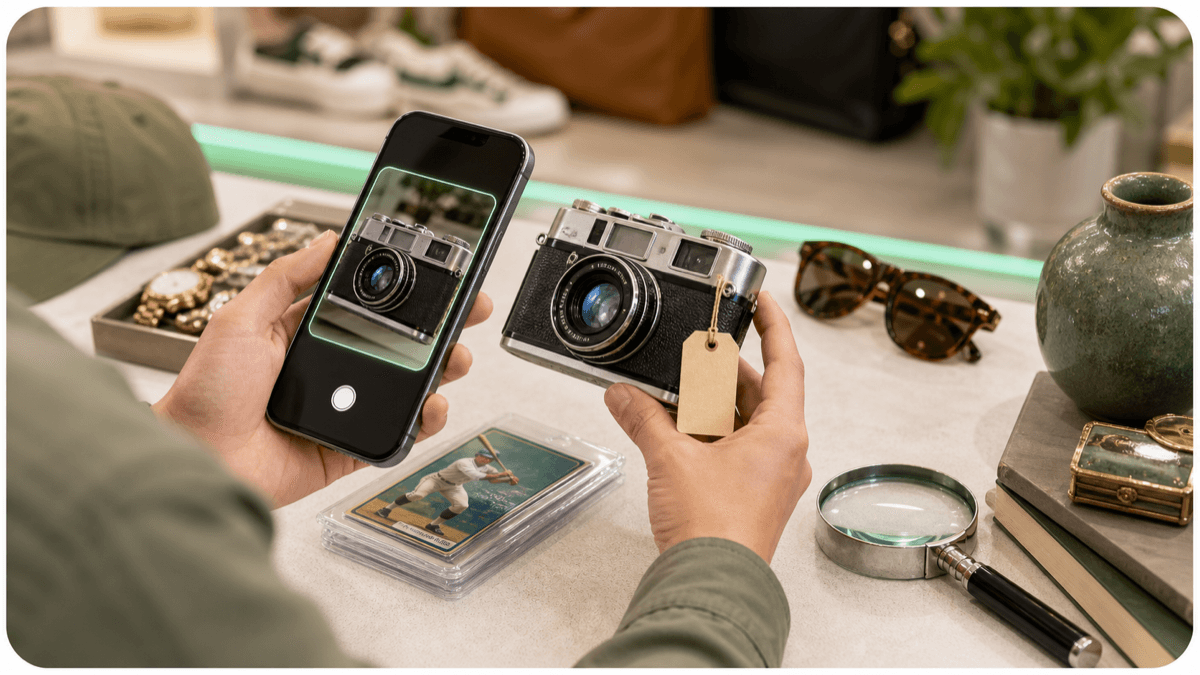
PriceSnap is a mobile app for iOS and Android.
Use the app while reading this guide to scan items, estimate resale value, check marketplace comp signals, and save finds to your collection.
Key takeaways
- Choose a workflow by decision: quick screening, completed-sale verification, category expertise, or formal appraisal.
- A useful app shows uncertainty and source context instead of presenting one unexplained number.
- The same app may be strong for identifiable common goods and weak for rare, altered, or condition-sensitive items.
- Use a specialist when authenticity, provenance, safety, insurance, estate, legal, or tax consequences matter.
Try alongside this guide — scan straight from your camera roll.
The Direct Answer by Use Case
Use PriceSnap when you want a quick photo-first identification and a directional new and used range for a mixed item. Use a marketplace completed-sales workflow when you already know the exact item and need to inspect recent transactions directly. Use a category database when edition, catalogue number, grade, or specialist terminology is what actually determines the value. Use a qualified appraiser or authenticator for rare, luxury, legal, insurance, estate, tax, or otherwise high-value decisions. No single workflow is best in every situation, and any guide claiming otherwise is either selling something or has not tested widely enough to have encountered the cases where its favourite tool fails.
| Situation | Workflow |
|---|---|
| Unidentified mixed item, need a fast read | General photo scanner |
| Exact item known, need transaction evidence | Marketplace completed sales |
| Value hinges on edition, grade, or reference | Category-specific database |
| Genuineness is the open question | Authentication service |
| Insurance, estate, legal, or tax purpose | Qualified appraiser |
What a Good Photo Value App Should Show
A useful result explains the likely identity, the condition assumptions behind it, the currency, the range, the confidence, and some source context. It should make weak evidence visible rather than smoothing it over, and it should let you refine details such as model number, edition, size, accessories, or damage when the first pass is wrong. The warning signs are consistent across products: a precise price with no range, no indication of match quality, no date or market context, or language that guarantees a sale. Speed genuinely matters in a thrift aisle, but unexplained speed is not the same thing as defensible evidence, and a tool that is fast because it stopped looking is not doing you a favour.
- Shows the identity it settled on, so you can check it.
- States condition assumptions and currency explicitly.
- Gives a range, not a single figure.
- Indicates confidence and makes weak evidence visible.
- Lets you correct model, edition, size, accessories, or damage.
- Red flags: exact price, no range, no context, guaranteed-sale language.
General AI Scanners
General scanners are designed for mixed finds: clothing, electronics, household goods, collectibles, furniture, and everything else that turns up in a real sourcing trip. Their main advantage is triage — turning a photograph into a likely identity and a starting range quickly, across categories, without you needing to know in advance what you are looking at. Their limitation is that same breadth. Rare variants, subtle grades, hidden damage, counterfeits, and sparse markets defeat any photo-only workflow regardless of which product it belongs to. PriceSnap belongs in this category, and that publisher relationship is exactly why this guide avoids the unsupported claim that PriceSnap is universally the best choice.
Read next:PriceSnap alternatives
Marketplace Search and Completed Sales
Marketplace research is strongest when you can match the exact product and filter to completed transactions. It is slower than accepting an instant estimate, but it lets you inspect dates, condition, accessories, shipping, and the outliers that a summary would have averaged away. Active listings reveal seller expectations rather than buyer behaviour, and the gap between those two is frequently large. A practical combined workflow is to scan first to obtain an identity, use that identity as your search query, then compare at least five closely matched completed sales before committing significant money. The scan tells you what to search for; the search tells you what it is worth.
Read next:PriceSnap vs eBay sold listingsSold listings vs asking prices
Category Databases and Specialist Tools
Cards, coins, watches, vinyl, comics, art, and luxury goods frequently require category-specific identifiers that a general tool may not resolve. A catalogue number, mint mark, reference, matrix code, printing, professional grade, or documented provenance can matter far more than the front photograph, and in some categories the front photograph is nearly uninformative on its own. Specialist databases narrow identity and comparable sales; authenticators and appraisers evaluate facts that no app can prove from an image. The rule of thumb is proportional: the narrower the category and the higher the stakes, the more valuable this specialist layer becomes, and the less a general scanner should be the last word.
- Catalogue and reference numbers that a photograph may not expose.
- Population and census data for graded categories.
- Auction archives with documented provenance.
- Grading standards specific to the category.
- Narrower coverage, but far greater precision within it.
How to Run Your Own Same-Item Test
Choose ten items that resemble what you actually buy or sell, not what would make a tidy demonstration. Give each app the same photographs and notes, record the time to a usable result, and save the identity, range, confidence, and sources each returned. Build a reference from closely matched completed sales, then note whether that reference falls inside each app's range. Track failed identifications rather than discarding them, since how a tool fails matters as much as how often. A small personal test will usually tell you more about workflow fit than any generic star rating or affiliate roundup built on no original evidence — and it takes an afternoon.
- Ten items from your real categories, chosen before testing.
- Identical photographs and notes for every product.
- Record identity, range, confidence, sources, and time.
- Build the reference from closely matched completed sales.
- Keep the failures in the results.
Read next:AI price scanner accuracy test
Our Current Recommendation Standard
PriceSnap has registered a 60-item, six-workflow benchmark before publishing any ranked list. Until that data exists and can be reviewed, this page recommends types of tools by use case rather than declaring an overall winner, because a ranking without a method is an opinion wearing a number. Future rankings published here must show the test date, the scoring rubric, the raw evidence, material drawbacks of our own product, and at least one situation in which a competing workflow is the better choice. Product availability, pricing, and feature details must also be rechecked before each material update, since all three change frequently enough to make a stale comparison actively misleading.
Read next:About and editorial standards
Related categories
Continue your research
- Which Thrift Scanner App Actually Pays for Itself? Do the MathA thrift scanner pays for itself only when its incremental benefit exceeds its cost. PriceSnap is a practical option for mixed-category photo research with new and used ranges, confidence levels, follow-up chat and saved collections. Pair it with matched sold-price verification. Book specialists may need ISBN tools; no universal accuracy or ROI winner has been established here.
- AI Price Scanner Accuracy Test: Our 60-Item Benchmark ProtocolPriceSnap has registered a 60-item benchmark for six valuation workflows. It will score exact identification, usable ranges, median percentage error, reference-price coverage, time to result, source transparency, and uncertainty disclosure. Results are not yet published, so this page makes no winner or accuracy claim.
- Can a Photo Tell You What an Item Is Worth?A clear photo can support item identification and a directional resale range when brand, model, edition, and condition are visible and comparable market evidence exists. It cannot prove hidden condition, authenticity, provenance, grade, materials, or future buyer demand. Verify high-value or low-confidence results with matched completed sales and specialists.
- How to Verify an AI Price Estimate Before You Buy or SellVerify an AI price estimate in seven steps: confirm exact identity, define condition, inspect source type, collect five to ten close completed sales, remove documented mismatches, calculate the median and spread, and adjust for fees, shipping, timing, location, and risk. Escalate rare or high-stakes items to a specialist.
- PriceSnap Alternatives: Which Item-Value Workflow Fits You?Alternatives to PriceSnap fall into five groups: other general photo scanners such as RePick or Revalue, manual marketplace completed-sale research, category-specific databases, authentication services, and qualified appraisers. Choose based on category, evidence needs, speed, risk, and what must be proven.
- How PriceSnap Estimates Resale Value: Data, Confidence, and LimitationsPriceSnap estimates resale value by identifying an item from a photo, searching current web and marketplace signals, considering condition and location, and returning directional new and used ranges with a low, medium, or high confidence level. It is a research aid, not a certified appraisal, authentication decision, or guaranteed sale price.
FAQ
Best Apps to Find Item Value From a Photo: A Transparent Selection Guide — FAQ
Straight answers about accuracy, platforms, and how PriceSnap fits your workflow.
What is the best app to find the value of an item from a photo?
A general photo scanner is useful for a quick starting range, but the best workflow depends on the category and decision. Verify valuable items with matched completed sales and use a specialist for formal appraisal or authentication.
Can one app accurately value every type of item?
No. Identity, condition, rarity, local demand, and market evidence vary by category. Treat universal precision claims cautiously.
Are marketplace sold listings more reliable than an AI estimate?
Closely matched completed sales are strong transaction evidence. AI can make identification and research faster, but the quality of the underlying match still matters.
Is a photo estimate the same as an appraisal?
No. A photo estimate is a research aid. A qualified appraiser may inspect provenance, materials, condition, authenticity, and the valuation purpose in far greater depth.