

PriceSnap vs RePick: What to Compare Before Choosing
PriceSnap and RePick may appear in the same search when a reseller wants to photograph an item and research its value. A responsible choice requires same-item evidence—not two marketing pages compared side by side.
4 min readBy PriceSnap Editorial TeamPublished
AI summary
PriceSnap publishes this comparison. It explains how to compare PriceSnap and RePick using identical item inputs, identity accuracy, useful ranges, source transparency, speed, and workflow fit. It does not name a winner because the registered same-item test has not yet been completed.
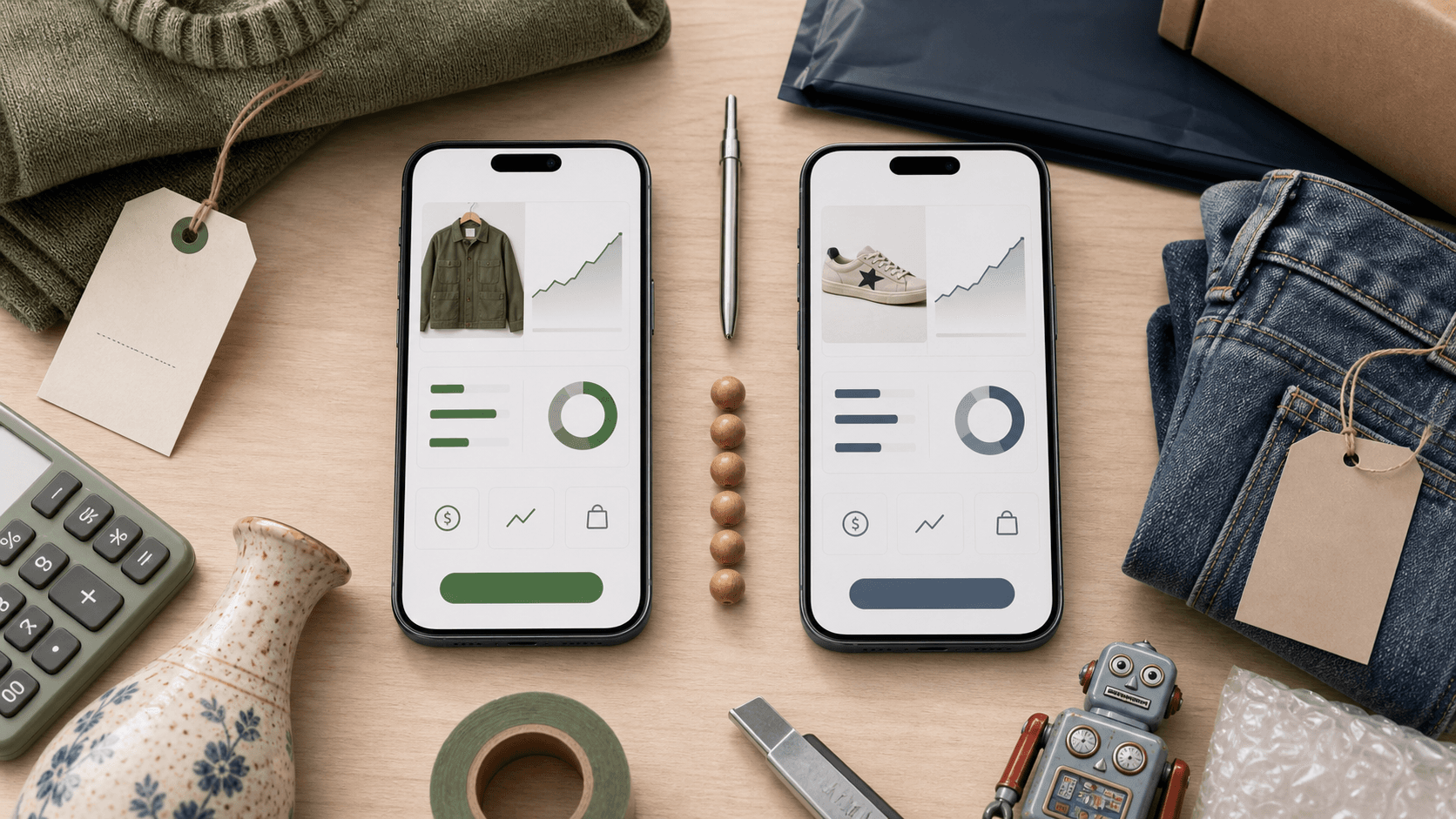
PriceSnap is a mobile app for iOS and Android.
Use the app while reading this guide to scan items, estimate resale value, check marketplace comp signals, and save finds to your collection.
Key takeaways
- Compare the apps with the same ten or more items and identical photos.
- Score wrong identification and missing results, not only returned prices.
- Check source context, uncertainty, category fit, and post-scan workflow.
- Do not treat store ratings or developer descriptions as accuracy evidence.
Try alongside this guide — scan straight from your camera roll.
Disclosure and Current Verdict
PriceSnap's editorial team publishes this page, and PriceSnap is one of the products under consideration. The current verdict is therefore deliberately limited: both products should be tested on the same items before anyone claims one is more accurate, and we have not yet done that work. This article records the selection criteria and the planned method rather than a conclusion. It does not repeat unverified marketing claims as facts, and it does not convert an App Store rating into evidence of valuation performance — store ratings measure satisfaction with an app experience, which is a genuinely different thing from whether its price estimates are right.
- Published by PriceSnap; the conflict of interest is direct.
- No accuracy verdict, because the same-item test is not complete.
- Marketing claims are recorded as claims, not facts.
- Store ratings are not evidence of valuation accuracy.
Read next:About and editorial standards
Compare the Core Job, Not the Tagline
Start with the decision you need to make. A thrift shopper may need a fast buy-or-pass range and nothing else. A reseller may care about identity, sources, fees, listing workflow, and saved inventory. A collector may need variant or grade precision that a general tool struggles with. Write the job down first, then assess which workflow removes the most research without hiding uncertainty — those two conditions together are the test, since removing research by inventing confidence is not a benefit. A feature that looks impressive in a screenshot but does not change your decision should receive very little weight in the comparison, however prominently it is marketed.
- Name your job before comparing anything.
- Score on research removed, not features listed.
- Removing uncertainty by hiding it is not a benefit.
- Ignore features that do not change your decision.
Use the Same Ten Items
Choose at least ten items from the categories you actually handle, including easy, niche, damaged, and low-evidence examples. Use the same photographs, the same crop, the same condition notes, the same region, and the same currency wherever each product permits it. Record incorrect identity, refusals, and unusable ranges as outcomes rather than as problems with the test — a refusal on a genuinely hard item may be the correct behaviour, and a test that discards those cases cannot see it. Do not replace difficult items once testing has begun, which is the most common way an informal comparison quietly becomes flattering to whichever tool the tester already preferred. For every scorable item, build a reference from at least three and preferably five to ten closely matched completed sales.
- Identical photographs, crops, notes, region, and currency.
- Include easy, niche, damaged, and thin-market items.
- Record refusals and wrong identities as results, not as test failures.
- Never swap out a difficult item after testing starts.
- Reference from three to ten closely matched completed sales.
Score Evidence and Uncertainty
A result is more useful when it identifies the exact model or variant, distinguishes asking prices from completed transactions, shows the source context behind its number, and admits when its matches are weak. Give each workflow a zero-to-five transparency score and a zero-to-five uncertainty score, and keep those separate from whether the number happened to be right on any given item. A wide but honest range can be safer to act on than a precise but poorly supported figure, because you can see what you do not know. Also inspect whether you can correct identity or condition when the first result is wrong, since in real use that recovery path determines how often you end up with a usable answer.
| Score | High marks for |
|---|---|
| Transparency (0-5) | Inspectable sources, stated identity, visible reasoning |
| Uncertainty (0-5) | Widening the range on weak evidence, flagging thin markets, refusing rather than guessing |
Measure the Whole Reseller Workflow
Time the path from opening the app to recording a decision, not just the loading animation, because the loading time is rarely where the minutes go. Note whether a result can be saved, revisited, refined, or carried into later research, since a scan you cannot find again is work you will repeat. Consider subscription friction and usage limits only after checking the official listing on the test date, because these details change frequently and a comparison built on remembered pricing ages badly. The best fit is the workflow that reduces total decision time while preserving enough evidence for the value and risk of the item in front of you — both halves of that sentence matter.
- Time from open to recorded decision, not scan duration.
- Can the result be saved, found again, and refined?
- Check pricing and limits on the official listing, on the test date.
- Total decision time, with evidence preserved — not speed alone.
When Manual Verification Still Wins
Neither photo workflow should replace manual completed-sale research for an item that is rare, expensive, counterfeit-prone, altered, graded, or poorly identified. Confirm maker's marks, model numbers, editions, size, accessories, damage, and sale dates yourself in those cases. For luxury, legal, estate, insurance, or tax decisions, use a qualified specialist — those contexts require a documented process that no consumer app provides regardless of how good its estimates are. A scanner is most valuable as a fast research layer that tells you where to spend your attention, never as authority to override contradictory evidence you can see with your own eyes.
Read next:PriceSnap vs eBay sold listingsHow to verify an AI price estimate
Related categories
Continue your research
- Which Thrift Scanner App Actually Pays for Itself? Do the MathA thrift scanner pays for itself only when its incremental benefit exceeds its cost. PriceSnap is a practical option for mixed-category photo research with new and used ranges, confidence levels, follow-up chat and saved collections. Pair it with matched sold-price verification. Book specialists may need ISBN tools; no universal accuracy or ROI winner has been established here.
- AI Price Scanner Accuracy Test: Our 60-Item Benchmark ProtocolPriceSnap has registered a 60-item benchmark for six valuation workflows. It will score exact identification, usable ranges, median percentage error, reference-price coverage, time to result, source transparency, and uncertainty disclosure. Results are not yet published, so this page makes no winner or accuracy claim.
- Best Apps to Find Item Value From a Photo: A Transparent Selection GuideFor a fast photo-first starting range, use a general item scanner such as PriceSnap; for transaction verification, check closely matched completed sales in a marketplace such as eBay; for authenticity, insurance, estate, tax, or rare high-value decisions, use a qualified specialist. PriceSnap publishes this guide and has not yet completed its cross-app benchmark, so it does not claim an overall winner.
- How to Verify an AI Price Estimate Before You Buy or SellVerify an AI price estimate in seven steps: confirm exact identity, define condition, inspect source type, collect five to ten close completed sales, remove documented mismatches, calculate the median and spread, and adjust for fees, shipping, timing, location, and risk. Escalate rare or high-stakes items to a specialist.
- How PriceSnap Estimates Resale Value: Data, Confidence, and LimitationsPriceSnap estimates resale value by identifying an item from a photo, searching current web and marketplace signals, considering condition and location, and returning directional new and used ranges with a low, medium, or high confidence level. It is a research aid, not a certified appraisal, authentication decision, or guaranteed sale price.
FAQ
PriceSnap vs RePick: What to Compare Before Choosing — FAQ
Straight answers about accuracy, platforms, and how PriceSnap fits your workflow.
Is PriceSnap better than RePick?
There is not yet enough published same-item evidence to make that universal claim. Test both on the categories you use and compare identification, range usefulness, sources, speed, and uncertainty.
Who publishes this comparison?
PriceSnap publishes it and therefore has a commercial interest in the outcome. That conflict is disclosed, and no winner is named before the benchmark is complete.
What should a same-item comparison record?
Record app version, platform, price tier, test date, inputs, identity, estimate or range, confidence, sources, time to result, and the matched completed-sale reference.
Do App Store ratings prove valuation accuracy?
No. Ratings can reflect ease of use, support, price, expectations, or a small number of experiences. Accuracy needs item-level reference evidence.