

7 min readBy PriceSnap Editorial TeamPublished
How to Find the Best Thrift Stores in the USA: A Reseller Guide
The best thrift store in America is rarely one universal chain or one viral location. It is the store near you that receives useful inventory, prices it reasonably, restocks often, and matches the categories you understand. This guide shows how to find thrift stores anywhere in the United States, which national chains are best for different types of finds, how to discover overlooked local nonprofit shops, and how to build a repeatable sourcing route instead of depending on luck.
AI summary
This guide explains how to find and evaluate the best thrift stores in the United States using official chain locators, targeted map searches, category fit, restock patterns, pricing, sell-through, route planning, and in-store value checks.
PriceSnap is a mobile app for iOS and Android.
Use the app while reading this guide to scan items, estimate resale value, check marketplace comp signals, and save finds to your collection.
Key takeaways
- Use official Goodwill, Salvation Army, Habitat ReStore, and Savers-family locators before relying on incomplete map results.
- Goodwill is strongest for broad variety, Habitat ReStore for furniture and building materials, and large Savers-family stores for organized volume.
- Independent nonprofit, church, hospital auxiliary, and community thrift stores can offer inventory and pricing that national lists miss.
- Score each location from repeated visits instead of assuming one chain, neighborhood, or review rating is always best.
- Scan and check sold comps before buying because a great thrift store can still contain unprofitable inventory.
Try alongside this guide — scan straight from your camera roll.
Quick Answer: The Best Store Depends on Your Category
Start with Goodwill for broad variety and access to Outlet filters, Salvation Army for mixed clothing and household goods, Habitat for Humanity ReStore for furniture and home-improvement inventory, and Savers, Value Village, Unique, or 2nd Ave. for large organized secondhand stores where available. Then search for independent nonprofit, church, school, animal-rescue, and hospital auxiliary thrift shops. A clothing reseller and a furniture flipper need different “best” stores. Your real winner is the location where your category knowledge repeatedly turns reasonable purchase prices into sellable inventory.
| If you source | Start with |
|---|---|
| Broad mixed inventory | Goodwill, including Outlet formats where available |
| Clothing and household basics | Salvation Army |
| Furniture, tools, fixtures, building materials | Habitat for Humanity ReStore |
| High-volume organised racks | Savers, Value Village, Unique, 2nd Ave. |
| Low-competition local finds | Independent nonprofit, church, hospital, and rescue shops |
Use Official Store Locators Before Map Apps
Map apps can contain duplicate donation centers, closed stores, or locations that do not offer retail shopping. Begin with official locator pages. Goodwill Industries International provides a ZIP-code locator with filters for Retail Store, Donation Site, Outlet, and specialty locations. The Salvation Army USA thrift-store page links to its store finder. Habitat for Humanity has a ReStore ZIP-code search. The Savers family locator covers Savers, Value Village, Unique, and 2nd Ave. stores by state. Save every promising retail location to one map, then confirm current hours by phone or the store’s official page before driving.
Goodwill: Best National Starting Point for Variety
Goodwill is a practical first search because its network includes about 150 local Goodwill organizations and many retail formats. Inventory can include clothing, shoes, media, toys, electronics, housewares, furniture, and collectibles, but pricing and donation routing vary by local organization. Use the official locator filters carefully so you do not confuse a donation site with a store. Also search for Goodwill Outlet locations, where eligible merchandise may be sold through bins or by weight. Do not assume every Goodwill follows the same sale calendar or sends local donations to the nearest store; evaluate each local organization from direct visits.
Salvation Army: Best for Mixed Household Basics
The Salvation Army reported 887 thrift stores across the United States on its official site when this guide was checked in June 2026. Stores commonly carry clothing, furniture, kitchenware, electronics, decor, and household necessities, with proceeds supporting local programs. Selection, sale colors, furniture volume, and pricing differ by territory. These stores can be especially useful when you want multiple departments in one stop rather than a narrow specialty shop. Use the official store finder, confirm that the location is a retail thrift store, and record which departments receive enough new inventory to justify repeat visits.
Habitat ReStore: Best for Furniture and Home Improvement
Habitat for Humanity ReStores are independently operated reuse stores connected to local Habitat organizations. Their official description highlights new and gently used furniture, appliances, home goods, building materials, fixtures, and renovation products. That makes ReStore a better first choice than a clothing-focused thrift shop for lamps, tools, cabinets, doors, hardware, architectural salvage, and local-pickup furniture. Inventory and donation criteria vary, so search by ZIP code and contact the local ReStore for current hours. Before buying large pieces, measure dimensions, inspect structural condition, and confirm transport and resale demand.
Savers, Value Village, Unique, and 2nd Ave.: Best for Organized Volume
The Savers family operates large secondhand stores under several names, including Savers, Value Village, Unique, and 2nd Ave. The official locator lists US locations across many states and notes that thousands of items may be stocked daily. These stores can be efficient when you want broad clothing racks, shoes, housewares, books, toys, and decor in a predictable layout. Pricing may reflect the organized retail format, so selection does not guarantee margin. Savers is a for-profit operator and its disclosures state that shopping does not directly support a nonprofit, although donated goods relationships can provide revenue to charity partners. Evaluate it on selection, price, and your goals.
Goodwill Outlets and Bin Stores: Best for High-Volume Sourcing
Outlet or bin formats can be useful for clothing, textiles, books, media, small goods, and bulk sourcing because some merchandise is priced by weight or rotated in large batches. They also require more time, condition inspection, and safety awareness. Use the Outlet filter on the official Goodwill locator rather than assuming every city has a bins location. Bring gloves if permitted, keep personal items secure, follow rotation rules, and inspect for stains, odors, broken parts, sharp objects, pests, and missing components. Low unit cost does not make damaged or unsellable inventory profitable.
Search Maps With Better Keywords
Do not stop at “thrift store near me.” Run separate searches for secondhand store, resale shop, vintage store, charity shop, nonprofit thrift, consignment store, used furniture, architectural salvage, used building materials, church rummage sale, flea market, estate sale, Goodwill Outlet, and Habitat ReStore. Zoom beyond your immediate neighborhood and search nearby towns because smaller cities may have stores that do not rank for a broad metropolitan query. Read recent reviews for evidence about current inventory, prices, parking, accessibility, and closures, but ignore one-off treasure stories that do not prove repeatable sourcing quality.
- Secondhand store, resale shop, vintage store, charity shop.
- Nonprofit thrift, consignment store, church rummage sale.
- Used furniture, architectural salvage, used building materials.
- Flea market, estate sale.
- Goodwill Outlet and Habitat ReStore as explicit searches.
- Zoom out to nearby towns — smaller shops see less reseller traffic.
Score Every Store Instead of Trusting a Ranking
Create a simple scorecard with five measures: category fit, average purchase price, fresh inventory frequency, sell-through of items you bought there, and travel time. Add condition quality and staff-confirmed sale days when relevant. A store with glamorous social-media finds may still be poor for your categories. Visit a promising location at least three times before judging it, then calculate how much sellable inventory and expected net profit you found per hour. The best thrift store for your business is the one that produces repeatable results after fuel, time, dead stock, and mistakes—not the one with the highest review count.
| Measure | What it tells you |
|---|---|
| Category fit | Whether it stocks what you can actually sell |
| Average purchase price | Whether pricing leaves you any margin |
| Fresh inventory frequency | Whether stock turns over between visits |
| Sell-through of what you bought | Whether its inventory converts for you specifically |
| Travel time | The cost that comes out of every item's margin |
Find the Real Restock Pattern
There is no universal best weekday or opening hour across US thrift stores. Some locations roll carts throughout the day, some stock heavily before opening, and others process donations on schedules controlled by a regional warehouse. Ask a simple, respectful question such as whether new items come out continuously or at certain times. Then test two or three time windows and record what you observe. Early arrival can increase access but also competition; midday can coincide with fresh carts; late visits may benefit from markdowns. Let local evidence replace internet folklore.
Build a Route That Protects Your Time and Fuel
Group stores into a loop instead of crossing a city for one uncertain stop. A strong route might combine one high-volume chain, one local nonprofit shop, one specialty source such as ReStore, and an estate or rummage sale. Record opening hours, sale days, parking, average visit time, strongest departments, and last productive visit. Drop stores that repeatedly fail your scorecard and replace them with new tests. A shorter route with three reliable locations can outperform a ten-store marathon because you preserve time for cleaning, photographing, listing, shipping, and bookkeeping.
Use a 60-Second In-Store Value Check
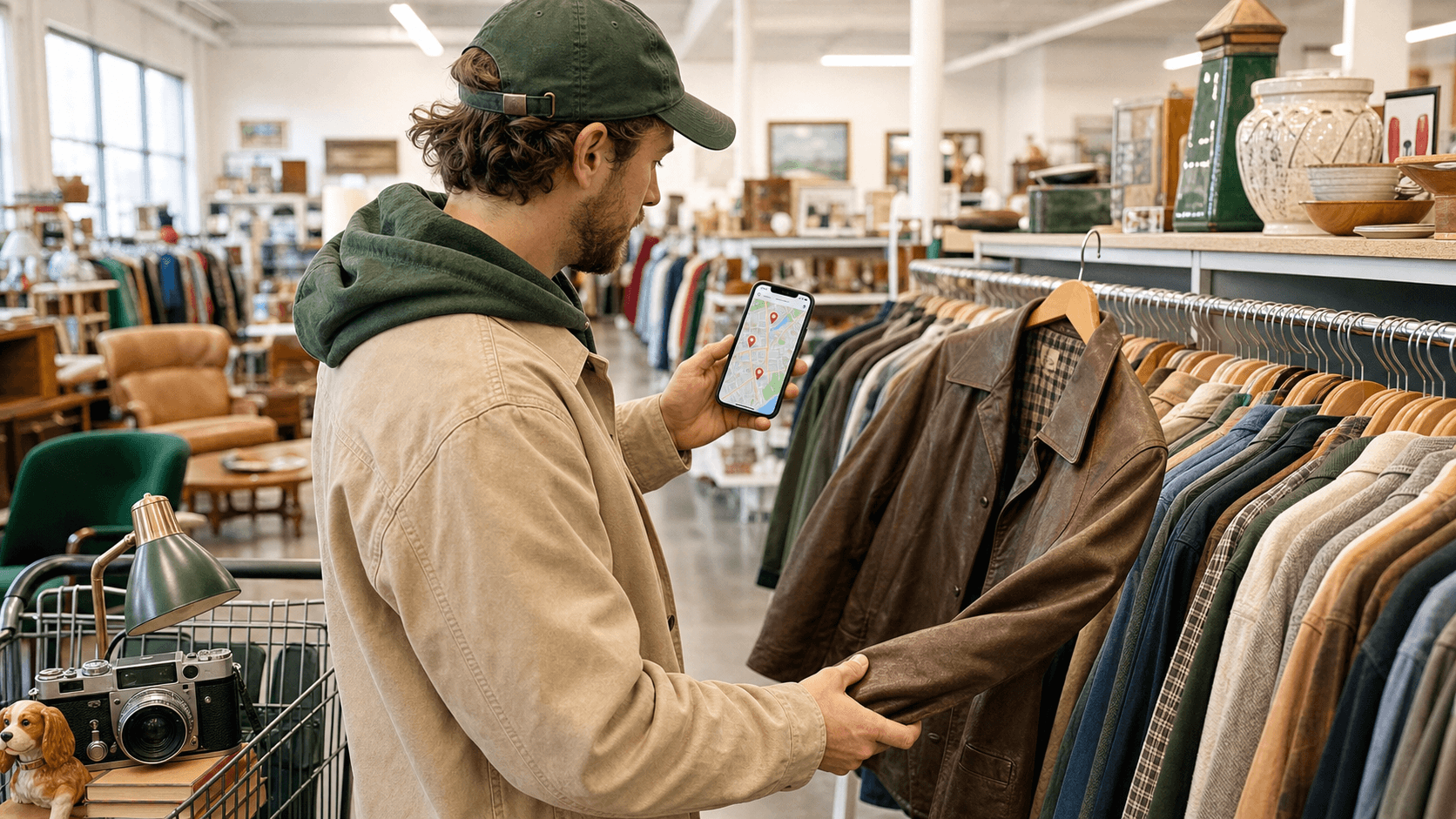
Finding a good thrift store is only the first filter. Before buying, identify the item precisely, inspect condition, find model numbers or maker marks, compare recent sold listings, estimate shipping, and subtract marketplace fees. PriceSnap can scan a photo and provide a directional identity and resale value range while you are in the aisle. Use that result to focus deeper research, not to skip it. Pass when identification is weak, comps are rare, condition is uncertain, shipping is bulky, authenticity risk is high, or the expected margin depends on the best sale ever recorded.
Official Locator Sources and Update Warning
National-chain information in this guide was checked in June 2026 against the official Goodwill Industries International thrift-store locator, Salvation Army USA thrift-store finder, Habitat for Humanity ReStore locator, and Savers-family store locator. Locations, store formats, hours, sale programs, and donation routing change frequently. Always verify a store on its official local page or by phone before making a long trip. Independent thrift stores are even more dynamic, so treat old directory pages and map reviews as leads rather than proof that a store is currently open.
Related categories
FAQ
How to Find the Best Thrift Stores in the USA: A Reseller Guide — FAQ
Straight answers about accuracy, platforms, and how PriceSnap fits your workflow.
What is the best thrift store chain in the USA?
There is no single winner. Goodwill offers broad coverage and variety, Salvation Army carries mixed household inventory, Habitat ReStore specializes in furniture and home-improvement goods, and Savers-family stores are often large and organized.
How do I find thrift stores near me?
Search official chain locators by ZIP code, then use map searches such as thrift store, charity shop, nonprofit resale shop, church thrift store, hospital auxiliary thrift, and Goodwill Outlet.
Which thrift stores are best for resellers?
The best reseller stores combine frequent fresh inventory, reasonable prices, categories you understand, and enough sell-through to justify the route. Measure results across several visits.
What is the best thrift store for used furniture?
Habitat for Humanity ReStore is a strong national starting point because ReStores focus on furniture, appliances, home goods, building materials, and renovation inventory.
When is the best time to visit a thrift store?
Restock schedules differ by location. Ask staff politely, observe when carts appear, test weekday mornings and afternoons, and track which time produces fresh inventory at your specific stores.