

Electronics Resale Value Guide: Phones, Consoles, Cameras, and Laptops
Used electronics can be great flips, but they can also create returns, shipping damage, and hidden defect risk. This guide explains how to estimate electronics resale value before buying, trading in, or listing a device.
5 min readBy PriceSnap Editorial TeamPublished
AI summary
This guide explains electronics valuation using exact model, storage or configuration, cosmetic condition, battery health, accessories, lock status, testing results, and sold comps.
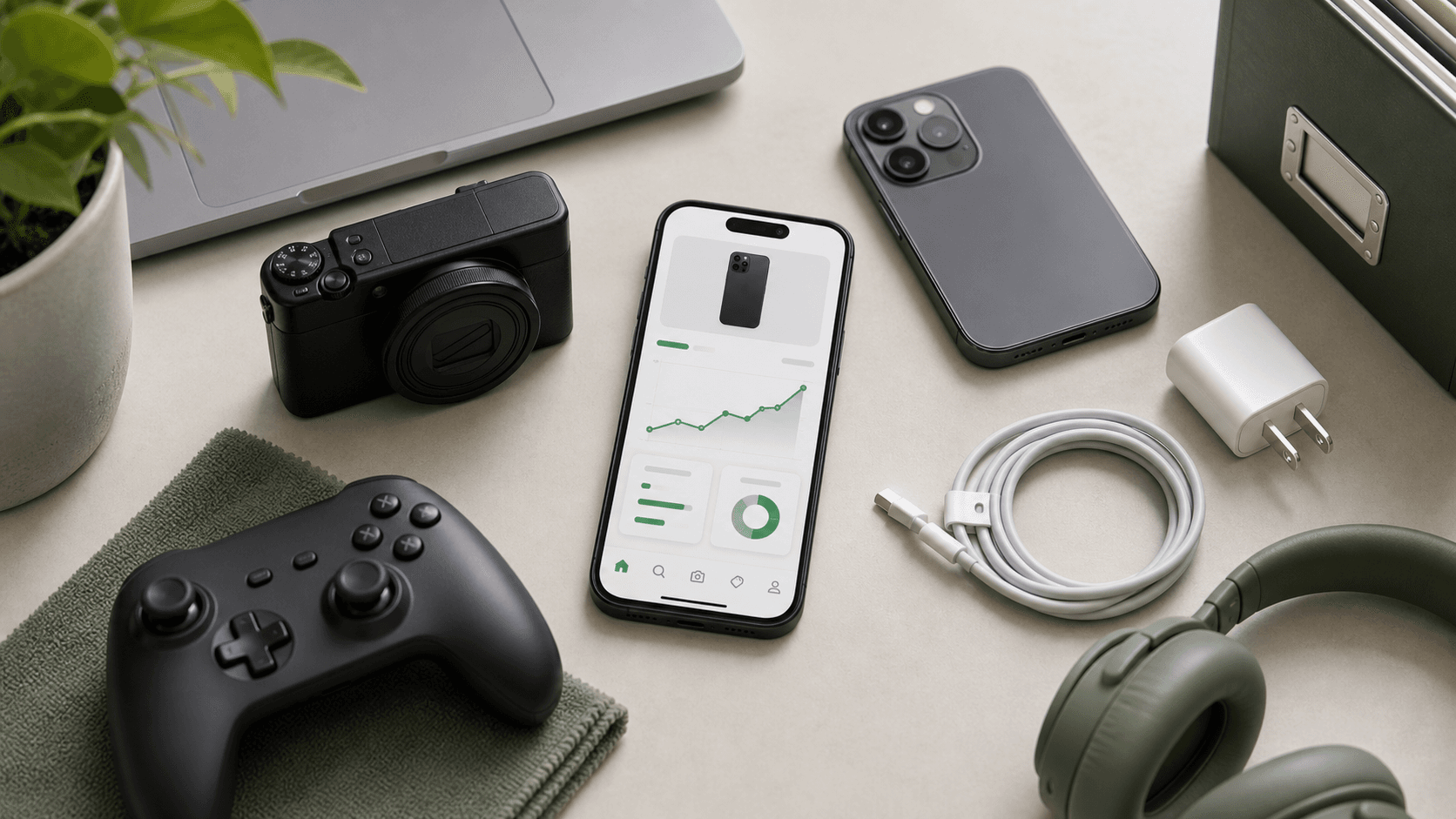
PriceSnap is a mobile app for iOS and Android.
Use the app while reading this guide to scan items, estimate resale value, check marketplace comp signals, and save finds to your collection.
Key takeaways
- Exact model, storage, carrier/lock status, generation, and configuration matter for electronics value.
- Testing reduces return risk and improves buyer confidence.
- Missing chargers, controllers, lenses, boxes, and accessories can lower resale value.
- PriceSnap can scan electronics as a starting point, but sellers should still test function before listing.
Try alongside this guide — scan straight from your camera roll.
Exact Model Beats Category
A phone, console, laptop, or camera must be identified precisely before pricing, because within a single product family the spread between configurations is often larger than the spread between generations. Look for model numbers, storage capacity, generation, carrier status, lens model, controller variant, or serial labels where safe to expose. On phones the model number is usually in Settings under About, and printed on the SIM tray or the back glass on older devices. On laptops it sits on the base panel or under the battery. On cameras the model is on the body and the lens carries its own separate identification. Small configuration differences change value significantly: storage capacity can double a phone's resale, a carrier-locked device sells for meaningfully less than an unlocked one, and a camera body sold with the correct native lens is a different product from a body alone. Record the configuration before you price, not after.
- Phones: model number, storage, carrier lock status, battery health percentage, activation lock state.
- Laptops: exact model and year, processor, RAM, storage, screen condition, battery cycle count.
- Consoles: revision or model number, storage, included controllers, cables, and whether it is region-locked.
- Cameras: body model, shutter count, sensor condition, included lens and its separate model number.
- Everything: whether the original power supply is the correct one for that device.
Read next:Electronics value checker
Condition and Function Testing
Cosmetic condition matters, but function matters more, and electronics is the category where the gap between the two is widest. A scratched laptop that works perfectly outsells a pristine one that does not charge. Test power, charging, buttons, ports, cameras, speakers, Wi-Fi, controllers, screens, battery health, and account lock status before you list. Account locks deserve special attention because they are the single most common way a resale goes wrong: an iPhone with Activation Lock, an Android with Factory Reset Protection, or a console still signed into a previous owner's account is close to worthless as a working device and must be described as parts-only. A tested item with clear notes earns more trust and fewer disputes than an item sold as-is, and the price difference usually exceeds the time the testing took. Where you genuinely cannot test something, say precisely what you did not test rather than implying it works.
| Check | Why it matters |
|---|---|
| Powers on and holds charge | Separates a working device from a parts listing |
| Account or activation lock cleared | A locked device cannot be used by the buyer at all |
| All ports and buttons | A single dead port moves the item down a condition tier |
| Screen at full brightness, white background | Reveals dead pixels, burn-in, and backlight bleed |
| Battery health or cycle count | Buyers increasingly expect this figure up front |
| Speakers, microphone, cameras | Cheap to test, common source of returns |
Accessories Change the Net Value
Chargers, controllers, cables, cases, lenses, memory cards, original boxes, and manuals can raise value or simply make an item easier to sell at the price you want. The effect is strongest where the accessory is proprietary and expensive to replace — a console power supply, a camera battery, a laptop charger with an unusual connector — because the buyer is pricing in the cost of sourcing it. Missing accessories also create hidden cost for you if you decide to complete the set before listing. Work out which side of that trade you are on before you buy: an item that is cheap because it is incomplete is only a good buy if the missing part is cheap and easy to find. Conversely, a complete-in-box item in a category where boxes are usually discarded can command a premium well beyond the cost of the cardboard.
- Proprietary power supplies and charging bricks — often the most expensive missing piece.
- Original controllers and their matching cables for consoles.
- Camera batteries, chargers, body caps, and lens caps.
- Original box and inserts, which matter disproportionately for collectible electronics.
- Software, activation keys, and manuals for older equipment.
Return Risk and Shipping Risk
Electronics carry higher dispute risk than almost any other resale category, for a simple reason: the item can be described accurately and still fail a week later. Manage that risk rather than ignoring it. Pack properly, with the device suspended away from the box walls and any loose accessory secured so it cannot strike the screen in transit. Photograph serial and model details before shipping where appropriate, which protects you against the rare but expensive swap dispute. Disclose flaws in the listing text rather than burying them in a photograph, and never claim a device works unless you tested the specific function you are claiming. Fragile or expensive electronics justify signature confirmation and adequate insurance. Build an expected return rate into your margin for this category rather than treating every sale as final; if the number only works when nothing is ever returned, it does not work.
Read next:Resale profit calculator
Trade-In vs. Private Sale
Trade-in offers are convenient but usually lower than private-party resale, and the gap is the price of certainty. A trade-in gives you a fixed number, no listing work, no shipping support, no returns, and immediate settlement. A private sale can pay considerably more but requires photography, listing, questions, shipping, and post-sale support, and it exposes you to the return risk described above. Compare the two paths using realistic net profit rather than headline sale price: subtract platform fees, shipping, packaging, and the value of your time from the private-sale figure before you set it against the trade-in quote. For older, lower-value, or heavily used devices the trade-in route often wins outright. For current-generation devices in good condition with clean account status, private sale usually wins by enough to justify the work.
| Trade-in | Private sale | |
|---|---|---|
| Price | Lower, fixed | Higher, variable |
| Effort | Minimal | Listing, shipping, support |
| Return exposure | None after acceptance | Yours to manage |
| Speed | Fast and predictable | Depends on demand |
| Best suited to | Older, damaged, or locked devices | Current-generation, tested, clean devices |
Know When an Item Is Parts-Only
There is an honest and often profitable listing category between working and worthless, and using it correctly protects your account as much as your margin. A device is parts-only when it does not power on, cannot be account-unlocked, has liquid damage, has a cracked panel you are not repairing, or fails a function central to its purpose. Listing such an item accurately as parts or repair generally returns less than a working device but far more than a dispute, a forced refund, and a defect on your seller record. Be specific about what is wrong and what you confirmed still works, because parts buyers are purchasing particular components and will pay more when they know which ones are intact. The trap to avoid is the optimistic middle listing — a device described as working "apart from" a significant fault — which attracts buyers who expect a working device and returns.
- Does not power on, or powers on only while connected to mains.
- Activation lock, Factory Reset Protection, or an account you cannot clear.
- Liquid damage indicators triggered, or visible corrosion.
- Cracked screen or digitiser you are not repairing before sale.
- A core function — charging port, disc drive, shutter — that fails.
How to Scan Electronics With PriceSnap
Photograph the front, the back, the model label, the accessories laid out together, and every visible flaw individually rather than hoping one wide shot covers them. Model labels are frequently small and low contrast, so get close and keep the label parallel to the camera. Add notes for storage capacity, battery health, test status, account lock state, and which accessories are included, since each of those moves the realistic range. PriceSnap will help you decide whether a device justifies deeper testing, a repair, or a straightforward listing — and for a mixed box of thrifted electronics, whether it is worth carrying home at all. Treat the result as a screening tool for where to spend your testing time, then let the test results set the final price.
Read next:Scan before you buyHow PriceSnap estimates resale value
Related categories
FAQ
Electronics Resale Value Guide: Phones, Consoles, Cameras, and Laptops — FAQ
Straight answers about accuracy, platforms, and how PriceSnap fits your workflow.
How do I calculate used electronics value?
Identify the exact model, configuration, storage, carrier or lock status, condition, accessories, and testing results, then compare recent sold comps.
What lowers electronics resale value?
Cracked screens, battery wear, missing accessories, account locks, water damage, untested status, broken ports, and heavy cosmetic wear lower value.
Should I sell electronics as tested or untested?
Tested electronics usually sell for more and create fewer disputes. Untested items should be priced lower because the buyer assumes risk.
Can PriceSnap scan electronics?
Yes. PriceSnap can scan many electronics and estimate directional resale value from visible model and condition cues.