

6 min readBy PriceSnap Editorial TeamPublished
PriceSnap vs ThriftAI: Which AI Thrift Scanner Is Better for Resellers?
PriceSnap and ThriftAI both sit in the same fast-growing category: AI thrift scanner apps that help shoppers estimate resale value before they buy. This comparison looks at public positioning, reseller workflows, strengths, tradeoffs, and which app is a better fit for different types of thrift buyers.
AI summary
This guide compares PriceSnap and ThriftAI as AI thrift scanner apps for resellers, covering public feature positioning, value estimates, profit workflows, sold-comp reasoning, category guidance, app availability, and which tool fits different thrift shopping use cases.
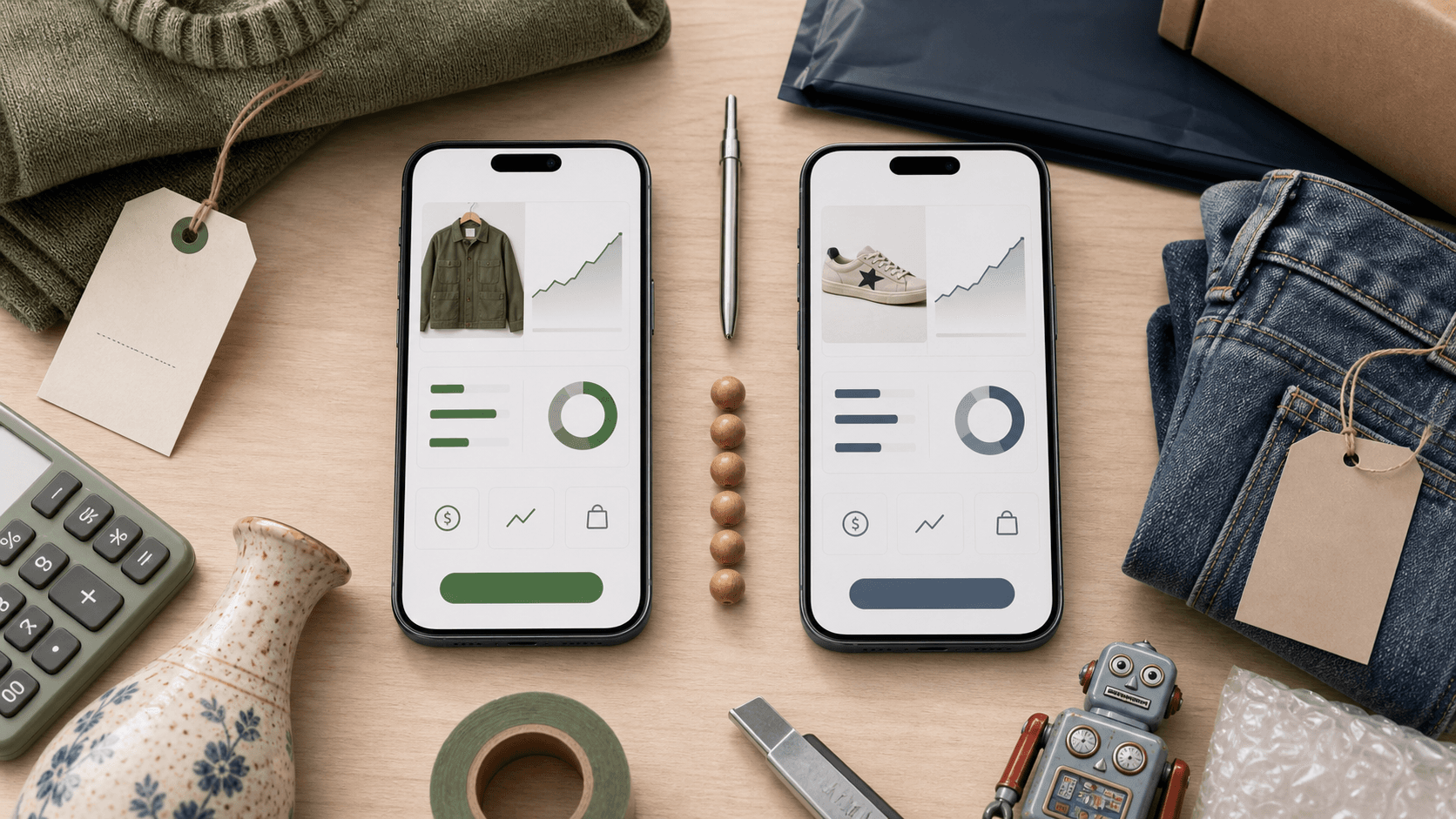
PriceSnap is a mobile app for iOS and Android.
Use the app while reading this guide to scan items, estimate resale value, check marketplace comp signals, and save finds to your collection.
Key takeaways
- Use PriceSnap when you want a broad item value scanner with category guides, scan-before-you-buy education, sold-comp reasoning, and resale decision support.
- Use ThriftAI when its public positioning around quick profit scans, authenticity checks, eBay listing, and reseller tracking matches your workflow.
- Both apps should be treated as decision-support tools, not final appraisals or guaranteed profit systems.
- For high-value luxury, watches, jewelry, or collectibles, use AI estimates as a starting point and verify authenticity, condition, and comps before buying.
Try alongside this guide — scan straight from your camera roll.
Short Answer
Choose PriceSnap if you want a broad AI value scanner with category-specific guides, sold-comp education, scan-before-you-buy workflows, AI chat, and collection tracking. Choose ThriftAI if its public promise of fast profit identification, authenticity checks, eBay listing, and reseller tracking is the exact workflow you want. The best choice depends on whether you need decision education around value or a narrowly optimised thrift-profit workflow. Note our position before you read further: PriceSnap publishes this comparison, so treat the framing as interested and the factual claims as checkable. Everything stated below about ThriftAI comes from its own public materials as of the date given in the next section, and you should verify current claims yourself before deciding.
Read next:About and editorial standards
What ThriftAI Publicly Promises
As of June 8, 2026, ThriftAI publicly positions itself as a profit identifier for thrift shoppers and resellers. Its website highlights instant profit scans, real marketplace data, brand and condition detection, authenticity checking, one-tap eBay listing, and tracking. Its App Store page presents it as ThriftAI: Profit Identifier for iPhone users. Those are strong promises for anybody who wants a reseller-first app focused on quick sourcing decisions. Two caveats apply to everything in this section. First, these are the company's own public claims rather than results we have independently benchmarked. Second, app features and positioning change, so a claim accurate on the date above may not be accurate when you read this — check the current App Store listing and website before you rely on any of it.
- Everything here is drawn from ThriftAI's own public materials.
- These are stated claims, not results we have benchmarked.
- Claims are dated June 8, 2026 and may have changed since.
- Verify against the current App Store listing before deciding.
Where PriceSnap Is Different
PriceSnap is positioned as an AI-powered price checker and value scanner for thrift finds, clothing, sneakers, collectibles, antiques, electronics, watches, jewellery, designer bags, cards, coins, comics, vinyl, and more. The substantive difference is the surrounding content and workflow rather than the core scan: PriceSnap pairs scanning with category-specific valuation guides, sold-comp reasoning, scan-before-you-buy education, and collection tracking, so that a user can understand why an item may or may not be worth buying rather than only being told a number. Whether that difference matters to you depends on where you are. If you already know your categories cold, education is overhead. If you are still building that knowledge, it is the part that compounds.
| PriceSnap | ThriftAI (public claims) | |
|---|---|---|
| Core pitch | Item value scanner across many categories | Thrift profit identifier |
| Category breadth | Cards, coins, comics, vinyl, watches, jewellery, bags, sneakers, electronics, antiques, toys | Thrift and resale focused |
| Listing workflow | Not a one-tap lister | One-tap eBay listing claimed |
| Authenticity | Explicitly out of scope; recommends specialists | Authenticity checking claimed |
| Education | Category guides, sold-comp reasoning, buy/pass workflows | Not the stated emphasis |
| Follow-up | AI chat and saved scan history | Tracking claimed |
Feature Comparison for Resellers
For quick thrift sourcing, both apps target the same core problem: identify an item from a photograph and estimate whether it has resale upside. ThriftAI publicly emphasises profit identification, eBay listing, authenticity checks, and tracking. PriceSnap emphasises item value scanning, new versus used price ranges, AI chat follow-up, category coverage, resale value education, and saved scan history. A reseller who wants listing speed may value ThriftAI's positioning; a reseller who wants broader item research and learning support may prefer PriceSnap. It is worth being clear about one difference in kind rather than degree: PriceSnap does not claim to check authenticity, and treats that as a question for a qualified specialist rather than a photograph. If in-app authenticity checking is central to your workflow, that is a genuine reason to look elsewhere.
Read next:How PriceSnap estimates resale value
Pros and Cons of ThriftAI
On the evidence of its public materials, ThriftAI's strengths are clear reseller positioning, profit-focused messaging, and stated features around marketplace data, brand and condition detection, authenticity checking, eBay listing, and tracking. The corresponding limitation is that this positioning is tightly centred on thrift profit, so users who want broader category education, general item valuation, or a content-rich learning path may still want an alternative. As with any AI valuation app — including ours — users should independently verify comparables, condition, and authenticity before acting on a result. We have not run a matched benchmark against ThriftAI, so this section describes positioning rather than measured performance, and should be read that way.
- Stated strengths: reseller focus, profit messaging, listing and tracking workflow.
- Stated limitation: narrow focus if you want broad category education.
- We have not benchmarked it; this is positioning, not measured performance.
- Verify comparables, condition, and authenticity regardless of app.
Pros and Cons of PriceSnap
PriceSnap's strengths are broad category coverage, scan-before-you-buy education, sold-comp reasoning, guides across many collectible and resale categories, AI chat follow-up, history and collection tracking, and clear positioning as an item value scanner rather than only a thrift-profit tool. The honest limitations: users who want a hyper-focused thrift-profit and listing workflow may prefer an app built entirely around that path, PriceSnap does not offer one-tap eBay listing, and it does not claim to authenticate items. It is strongest when you want both a fast scan and the context to interpret it, and weakest as a pure speed tool for somebody who already knows exactly what they are looking at and simply wants to list it.
- Strengths: category breadth, education, sold-comp reasoning, chat, history.
- No one-tap eBay listing workflow.
- No authenticity claim — treated as a specialist question.
- Best when you want context with the number, not just the number.
Best App by Use Case
For beginner thrifters, PriceSnap is useful because it explains value signals and links into guides on profit maths, sold listings, and items to avoid — which is the knowledge that determines outcomes far more than scan speed does at that stage. For experienced thrift flippers focused on throughput, ThriftAI may appeal if its profit-scan and listing workflow fits an established process. For collectors and multi-category sellers, PriceSnap has broader public coverage across cards, coins, comics, vinyl, watches, jewellery, designer bags, sneakers, electronics, antiques, and vintage toys. If your sourcing is concentrated in one category, breadth matters less than depth in that category, and the right test is which app performs better on the specific things you actually buy.
| If you are | Consider |
|---|---|
| New to reselling and still learning categories | PriceSnap — the education compounds |
| An experienced flipper optimising for throughput | ThriftAI, if its listing workflow fits yours |
| A multi-category collector | PriceSnap — broader public category coverage |
| Concentrated in one category | Whichever performs better on that category in your own test |
How to Compare Results Fairly
To compare any two valuation apps fairly, scan the same item in the same lighting, supply the same condition details, and then check both results against recent completed sales rather than against each other. Do not judge either app on one unusual item; a single result tells you almost nothing, and the item most likely to produce a dramatic difference is precisely the one least representative of your ordinary sourcing. Test common thrift categories, branded clothing, sneakers, small electronics, collectibles, and luxury-risk items separately, because data quality and authenticity risk differ so much by category that an app can be strong in one and weak in another. Record what you tested and when. A comparison you cannot reproduce is an anecdote.
- Same item, same lighting, same condition notes, both apps.
- Judge both against completed sales, not against each other.
- Test at least ten items per category; one item proves nothing.
- Separate results by category — performance varies sharply.
- Write down what you tested and the date.
Read next:AI price scanner accuracy testHow to verify an AI price estimate
Which One Should You Try First?
Try PriceSnap first if your goal is to understand item value, compare new and used ranges, learn why completed sales matter, save scans, and make better buy or pass decisions across many categories. Try ThriftAI first if you specifically want to test its thrift-profit identifier workflow and its public claims around fast sourcing and listing. Serious resellers will often test both and keep whichever gives more useful estimates in the categories they actually source, which is the only comparison that matters for your business. Both apps are inexpensive relative to a single bad sourcing decision, so the cost of running your own test is low and the value of the answer is specific to you in a way no published comparison can be.
Read next:PriceSnap alternatives
Related categories
FAQ
PriceSnap vs ThriftAI: Which AI Thrift Scanner Is Better for Resellers? — FAQ
Straight answers about accuracy, platforms, and how PriceSnap fits your workflow.
Is PriceSnap a ThriftAI alternative?
Yes. PriceSnap is a ThriftAI alternative for users who want an AI price scanner, resale value estimator, sold-comp reasoning, category-specific valuation guides, and scan-before-you-buy workflows.
What is the main difference between PriceSnap and ThriftAI?
Based on public positioning, ThriftAI emphasizes profit scans, marketplace data, authenticity checks, eBay listing, and tracking. PriceSnap emphasizes broad item valuation, category-specific price guides, AI chat, scan-before-you-buy decisions, and collection tracking.
Which app is better for beginners?
PriceSnap is a strong fit for beginners who need education around sold comps, condition, category value signals, and buy/pass decisions, not just a quick number.
Should I trust an AI thrift scanner completely?
No. AI thrift scanners are useful starting points, but resellers should still verify sold comps, condition, authenticity, fees, shipping, and sell-through before buying or listing.