

Vinyl Record Value Guide: Pressings, Matrix Numbers, Condition, and Comps
Vinyl record value depends on details that are easy to miss: pressing, label variation, catalog number, matrix/runout, sleeve condition, media grade, and collector demand. This guide shows how to price records with more confidence.
5 min readBy PriceSnap Editorial TeamPublished
AI summary
This guide explains vinyl valuation using artist, title, pressing, catalog number, matrix/runout, label variation, media and sleeve grade, scarcity, and recent sold comps.
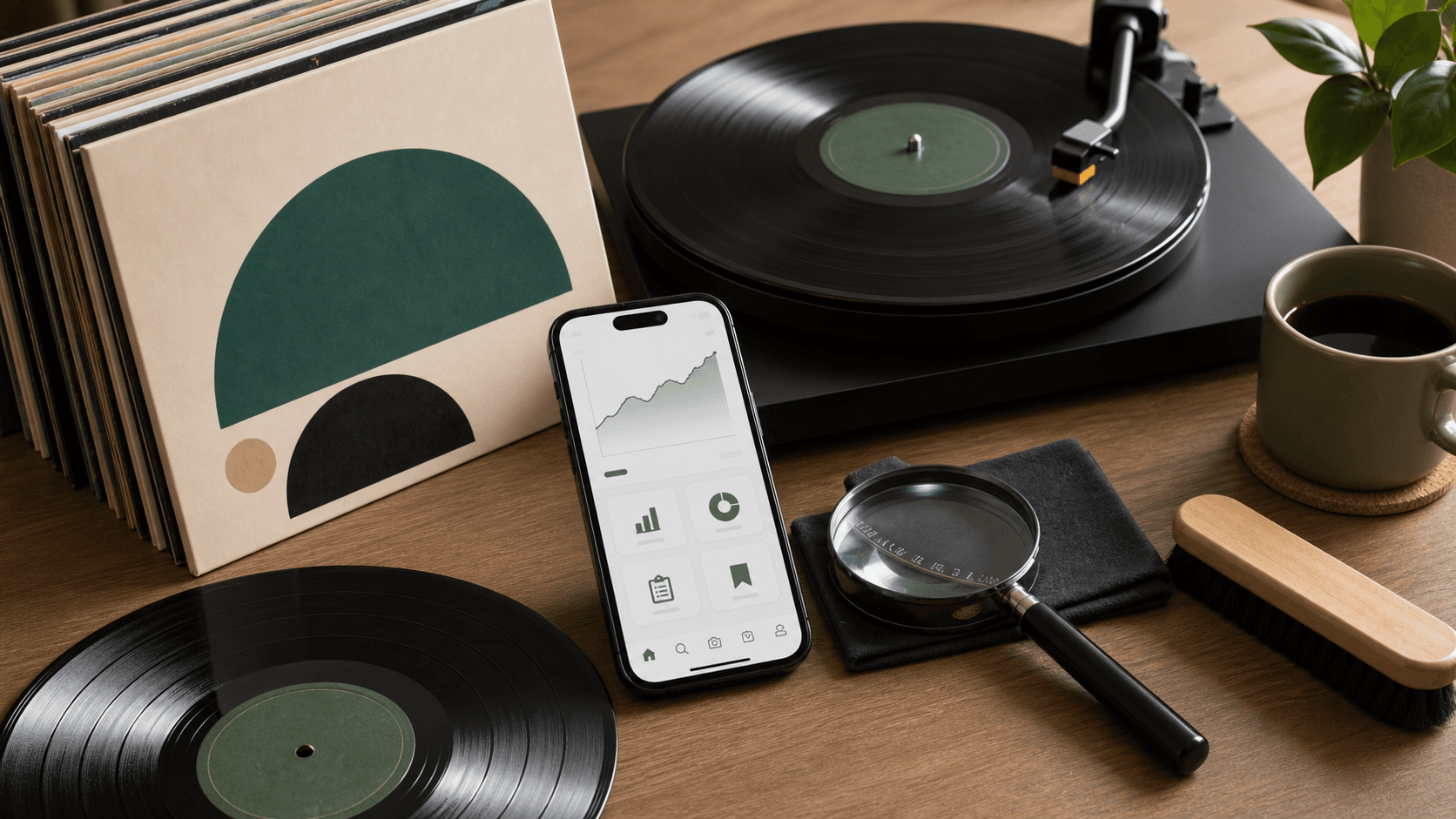
PriceSnap is a mobile app for iOS and Android.
Use the app while reading this guide to scan items, estimate resale value, check marketplace comp signals, and save finds to your collection.
Key takeaways
- Pressing and label details often matter more than album title alone.
- Media condition and sleeve condition should be graded separately.
- Matrix/runout numbers, catalog numbers, promos, and imports can identify valuable variants.
- PriceSnap can scan covers and labels to help start a record value estimate.
Try alongside this guide — scan straight from your camera roll.
Pressing Matters More Than Title
A record is not just an album title, and treating it as one is the single most common way collectors lose money in both directions. Original pressings, later reissues, imports, club editions, promos, coloured vinyl, picture discs, and limited variants of the same album can sell for wildly different amounts, and they frequently look identical from three feet away. Start by finding the catalogue number, the label design, the country of manufacture, and the matrix or runout marks etched into the dead wax. The label design alone often dates a pressing to within a few years, because labels redesigned their artwork periodically and collectors have documented those changes in detail. Club editions — records pressed for mail-order music clubs — are usually worth less than the retail pressing and can be identified by a small mark on the label or the jacket. The discipline is simple: identify the pressing before you look up a price, never the other way around.
- Catalogue number, printed on the label, the spine, and often the jacket rear.
- Label design and colour, which changed over a title's print history.
- Country of manufacture, printed on the label or in the rim text.
- Matrix and runout codes etched or stamped in the dead wax.
- Jacket construction, such as a gatefold, and whether the spine text matches the pressing.
Read next:Vinyl record value checker
Read the Label and the Runout
The label and the dead-wax runout together usually reveal the exact version, and learning to read them is the highest-return skill in record collecting. The runout is the smooth band between the last groove and the label, and it carries catalogue numbers, side identifiers, mastering engineer initials, pressing plant marks, and stamped or etched matrix codes. Those marks distinguish a first pressing from a later run cut from the same masters, and in some cases they identify a specific mastering that collectors seek out by name. Read them under a raking light, holding the record at an angle so the etching catches the light rather than disappearing into the black. Photograph these details clearly when using PriceSnap or when asking another collector for help, because a legible runout photograph will usually get you a definitive answer where a picture of the jacket will not. Note whether codes are machine-stamped or hand-etched; that distinction itself carries information.
| Mark | What it usually indicates |
|---|---|
| Catalogue number | Confirms the release and often the region |
| Side identifier (A/B, 1/2) | Which side, and sometimes which lacquer cut |
| Mastering initials | The engineer who cut the lacquer — sometimes a premium signal |
| Plant marks or symbols | Which pressing plant produced the record |
| Stamper or lacquer suffix | How late in the run this particular copy was pressed |
Grade Media and Sleeve Separately
A clean sleeve wrapped around a scratched record is not near mint, and a great record in a damaged sleeve also needs a discount. The convention is to grade the two separately and state both, usually written as a pair such as media grade over sleeve grade. Buyers rely on that convention, and collapsing it into a single optimistic word is a reliable way to earn a return. Common media issues include scratches, warps, groove wear, scuffs, and skips; common sleeve issues include seam splits, ring wear, writing, sticker residue, water damage, and corner bumping. Grade the record under good light, tilting it to reveal scuffs that vanish when viewed straight on, and be honest about anything you can feel with a fingernail. Where you can, play-grade rather than visual-grade: a record that looks clean can still tick, and a record with light marks can play silently. Say which method you used.
- State media and sleeve grades separately, in that order.
- Tilt the record under a light to reveal scuffs invisible head-on.
- Note whether the grade is visual or play-tested — buyers care which.
- Check the seams on all three edges of the jacket for splits.
- Look for ring wear, the circular impression the record leaves on the jacket.
- Disclose writing, stickers, cut-out marks, and any water staining.
Use the Right Comps
Compare sales for the same pressing at a similar grade. A sealed reissue, a first pressing, and a worn later copy of the same album should never share a price, and averaging them produces a number that describes nothing. If you cannot confirm the pressing, price conservatively until you can — the downside of underpricing a record you can relist is smaller than the downside of a dispute over a misdescribed first pressing. Watch for two distortions specific to this category. Sealed records carry a premium that partly reflects the gamble on what is inside, so a sealed comp is not a guide to an opened copy's value. And rare records often have very thin sale histories, which means a single enthusiastic result can look like a market level when it was one bidding war. Prefer a cluster of consistent sales, and where the history is genuinely sparse, say so in your own notes rather than pretending to a precision you do not have.
Read next:Sold listings vs asking prices
Collections vs. Single Records
A collection's value is not the sum of every optimistic individual listing, and this is where inherited or bulk-bought collections most often disappoint. Bulk lots sell at a discount because the buyer absorbs sorting time, condition risk, storage, and the near-certainty that most of the records are common. The efficient approach is to triage rather than to price everything individually or dump everything as one lot. Pull out anything with a recognisable pressing, an in-demand artist, or unusual packaging and research those individually. Group the rest by genre and condition and price them as lots, because a coherent lot of forty jazz records sells better than forty separate listings of common titles that each cost you time and a fee. Be realistic about the long tail: mainstream titles pressed in enormous quantities are usually worth little regardless of condition, and their value is in the volume, not the individual record.
| Pile | What goes in it | How to sell it |
|---|---|---|
| Research individually | Recognisable pressings, sought-after artists, unusual packaging | Individual listings with full pressing detail |
| Group by genre | Decent condition, common titles, coherent theme | Themed lots of ten to fifty |
| Bulk or donate | Heavily worn, damaged sleeves, very common titles | Single bulk lot or local sale |
Handling and Storage Protect the Grade
Records lose condition through ordinary handling more readily than most collectibles, and almost all of that loss is preventable. Store records vertically and reasonably tight, but never compressed: leaning stacks warp jackets and flat stacks press the records at the bottom. Keep them away from radiators, sunny windows, external walls, and unheated spaces, because heat warps vinyl and humidity swells and splits jackets. Handle records by the edges and the label only, since fingerprints leave oils that attract dust into the grooves. Replace inner sleeves that are paper-only with lined or anti-static sleeves, as bare paper scuffs the surface every time the record goes in and out. Outer sleeves protect the jacket from ring wear and shelf abrasion for very little cost. None of this improves a record you already own; it stops the slow erosion of the grade you paid for, which is where most collection value quietly disappears.
- Store vertically, snug but never compressed; never stack flat.
- Keep away from heat sources, direct sun, and damp external walls.
- Handle by the edges and label only.
- Replace bare paper inner sleeves with lined or anti-static ones.
- Use outer sleeves to prevent ring wear and shelf abrasion.
How to Scan Records With PriceSnap
Photograph the jacket front, the spine if the text is legible, the record label, the catalogue number, and any matrix or runout detail you can capture. The runout shot is the one that most often changes the answer, so take it under an angled light and get close enough that the etched characters are readable. Add notes for media and sleeve condition and whether the record is still sealed. The more precise the pressing evidence you supply, the more useful the estimate becomes — a scan with a legible runout is answering a much better-specified question than a scan of a jacket alone. Use the result to decide where to spend research time across a crate, then confirm the pressing yourself before you set a price on anything that comes back high.
Read next:How PriceSnap estimates resale valueThrifting guide
Related categories
FAQ
Vinyl Record Value Guide: Pressings, Matrix Numbers, Condition, and Comps — FAQ
Straight answers about accuracy, platforms, and how PriceSnap fits your workflow.
How do I find the value of a vinyl record?
Identify the artist, title, pressing, catalog number, matrix/runout, label variation, and condition, then compare recent sales for the same version.
Are first pressings always valuable?
First pressings often carry premiums, but value still depends on artist demand, rarity, condition, and whether collectors can verify the pressing.
How should I grade vinyl condition?
Grade the media and sleeve separately. Scratches, warps, noise, split seams, ring wear, writing, and water damage all affect value.
Can PriceSnap scan vinyl records?
Yes. PriceSnap can scan record covers and labels to help identify albums and estimate directional resale value.