

Comic Book Value Guide: First Appearances, Variants, Grading, and Comps
Comic book value depends on more than the character on the cover. Issue number, first appearance status, printing, variant, age, condition, and grading can move a book from dollar-bin to high-value collectible.
5 min readBy PriceSnap Editorial TeamPublished
AI summary
This guide explains comic book valuation using title, issue number, era, first appearances, printings, variants, newsstand copies, condition, grading, and recent sold comps.
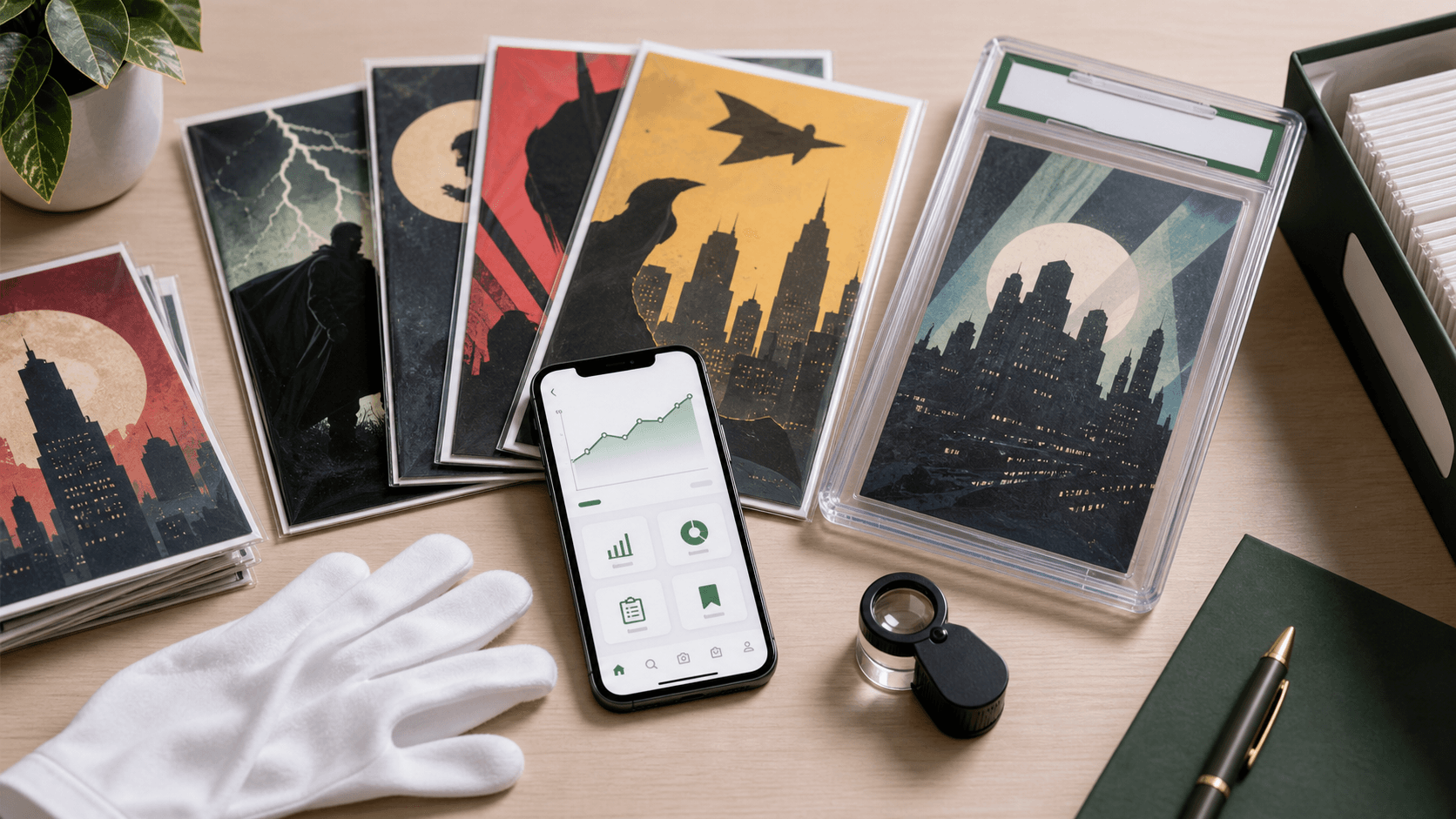
PriceSnap is a mobile app for iOS and Android.
Use the app while reading this guide to scan items, estimate resale value, check marketplace comp signals, and save finds to your collection.
Key takeaways
- Comic value starts with exact title, issue number, publisher, date, printing, and variant.
- First appearances, key issues, newsstand editions, and low-print variants can command premiums.
- Condition and grading can change comic value by multiples.
- PriceSnap can scan comic covers for a fast identification and value starting point.
Try alongside this guide — scan straight from your camera roll.
Identify the Exact Comic
Start with title, volume, issue number, publisher, cover date, barcode, printing, and cover variant. Many comics share the same character or title but belong to different volumes launched years apart, and an issue number alone is close to meaningless without the volume that contains it. The indicia — the small block of legal text usually inside the front cover or on the first page — is the authoritative source: it carries the full title, the volume, the issue number, the publication date, and often the printing. A first print and a later print can look nearly identical on the cover while selling for very different amounts, and later printings frequently announce themselves only in that indicia block or through a changed cover colour. Photograph the indicia alongside the cover whenever you are pricing something that might matter. Direct-market and newsstand editions of the same issue are also distinguished at the barcode, not on the cover art.
- Cover: title, issue number, cover date, and cover artist where credited.
- Indicia: full legal title, volume, printing, and actual publication date.
- Barcode box: distinguishes newsstand from direct-market editions.
- Price box: helps date the issue and spot foreign-market variants.
- Back cover: variant advertising differs between newsstand and direct copies.
Read next:Comic book value checker
Know the Key-Issue Signals
Collectors pay premiums for first appearances, origin stories, significant deaths, first team appearances, classic covers, and historically important runs. These are the issues where demand concentrates, and they are the reason a single book from a long box can be worth more than everything around it combined. Newsstand editions, low-print variants, retailer incentives, and ratio variants can also carry premiums, but only where demand actually exists — scarcity without demand produces a book that is hard to find and equally hard to sell. Be careful with the word "first": there is a meaningful difference between a character's first cameo appearance, first full appearance, first cover appearance, and first appearance in a particular costume, and the market prices these differently. Media announcements move key-issue prices sharply and often temporarily, which cuts both ways depending on whether you are buying or selling into the spike.
| Term | What it means |
|---|---|
| First appearance | The character's first published appearance, sometimes split into cameo and full |
| Cameo | A brief or partial appearance, often a single panel or a silhouette |
| Origin issue | The story establishing the character's backstory, not always the first appearance |
| Newsstand | Sold through general retail; usually printed in smaller numbers in later years |
| Direct edition | Sold through comic shops; identified at the barcode box |
| Ratio variant | A cover distributed to retailers at a fixed ratio against base orders |
Condition and Grading Basics
Comic condition depends on spine ticks, colour breaks, corner blunting, tears, stains, writing, staple rust, page colour, and cover gloss. The grading scale runs from Poor at the bottom to Gem Mint at the top, and the practical consequence is that a small number of visible defects can drop a book several tiers. High-grade modern comics need to be genuinely clean to command premiums, because the supply of clean modern copies is large and buyers can afford to be selective. Older books behave differently: a Golden or Silver Age key in a mid or low grade can still be valuable when demand is strong, because high-grade copies barely exist. Two defects are worth learning to spot early because they are frequently missed and heavily penalised: colour-breaking spine ticks, where the crease has gone through the ink to the white paper beneath, and restoration or trimming, which must always be disclosed and moves a book into a separate market.
- Spine ticks — note whether each one breaks colour through to white paper.
- Corner blunting and creases, checked on all four corners front and back.
- Page colour, from white through off-white to tan and brittle.
- Staple rust, staple tears, and whether staples have migrated.
- Writing, stamps, subscription creases, and date stamps.
- Any restoration, colour touch, or trimming — always disclosed.
Raw vs. Graded Comics
Raw comics are easier and cheaper to sell casually, while graded comics provide third-party authentication and a standardised condition grade in a sealed holder. CGC and CBCS slabs improve buyer confidence for higher-value books, and for keys they often widen the buyer pool enough to more than repay the fee. The decision is arithmetic rather than preference: grading costs a fee per book plus shipping both ways plus the time the book spends in the queue, and it only makes sense when the expected grade lifts the price by more than that total. For low-value books the fee alone exceeds any benefit. Two other considerations matter. First, grading is a gamble on the grade — a book you assess as high grade may come back lower, and the fee is spent either way. Second, a slabbed book cannot be read or re-examined, which suits investors and frustrates readers; know which of those your likely buyer is.
Read next:Sold listings vs asking prices
Compare Sold Comps Carefully
Use recent sales for the same issue, the same printing, the same variant, and a similar grade. Do not compare a raw mid-grade copy against a high-grade slab; those are effectively different products that happen to share a title. When you are comping a graded book, match the grading company as well as the number, because the market does not treat every label as equivalent. If comps are thin, widen the time range rather than loosening the specification, and lower your confidence in the result. Be especially careful with key issues during a media news cycle: sales from the fortnight after an announcement can sit far above the level the book returns to a few months later, so a comp set drawn entirely from a spike will mislead you. Where you can see both, a run of consistent sales tells you more than a single high outlier, however tempting that outlier is.
- Match issue, volume, printing, and variant before you look at price.
- Match grade, and for slabs match the grading company too.
- Prefer a cluster of consistent sales over a single high result.
- Check the sale dates — a spike week is not a baseline.
- Treat restored or trimmed copies as a separate market entirely.
Storage Protects the Grade You Already Have
Condition is the largest single lever on comic value, and unlike most collectibles a meaningful part of that condition is lost after acquisition rather than before. Comics degrade from light, humidity, heat, acid migration, and pressure, and every one of those is controllable. Bag and board each book you intend to keep, using an appropriately sized bag so the comic neither rattles nor bends. Store boxes upright rather than flat, because a stacked pile presses the books at the bottom and produces exactly the spine and corner damage that costs grades. Keep boxes off concrete floors, out of direct sunlight, and away from unheated garages and lofts where humidity swings. Acid-free boards and bags cost slightly more than the basic equivalents and slow the yellowing that turns white pages tan. None of this raises the grade of a book you already own — it prevents the slow, invisible loss of the grade you paid for.
- Bag and board every book you intend to hold, in a correctly sized bag.
- Store boxes upright; never stack comics flat under weight.
- Keep boxes off concrete and away from external walls.
- Avoid direct sunlight and any space with large humidity swings.
- Prefer acid-free bags and boards for anything you value.
How to Scan Comics With PriceSnap
Photograph the full front cover in good, even light with the book flat and the camera square to it, then add photographs of the barcode box, the indicia, the spine, and any damage. Angled shots distort the cover and hide the spine ticks that determine grade, so take the extra second to line the shot up. Where a book might be a key issue, the indicia photograph is the one that separates a first print from a later one, and it is worth capturing every time. PriceSnap can help identify the book and return a value range that tells you whether deeper comic research is worth your time — whether this is a long-box filler or something to look up properly, grade, and list on its own. For anything that comes back high, confirm the printing and grade yourself before you set a price.
Read next:How PriceSnap estimates resale valueVintage toys value guide
Related categories
FAQ
Comic Book Value Guide: First Appearances, Variants, Grading, and Comps — FAQ
Straight answers about accuracy, platforms, and how PriceSnap fits your workflow.
How do I find out what a comic book is worth?
Identify the title, issue number, publisher, date, printing, variant, key status, and condition, then compare recent sold listings for the same book.
What makes a comic book valuable?
First appearances, key storylines, low print runs, rare variants, newsstand editions, age, high grade, and collector demand can all increase value.
Does CGC grading increase comic value?
For valuable books, professional grading can increase buyer trust and liquidity, but grading costs only make sense when the expected value supports it.
Can PriceSnap scan comic books?
Yes. PriceSnap can scan a comic cover and provide a directional value estimate based on visible identification and market signals.